
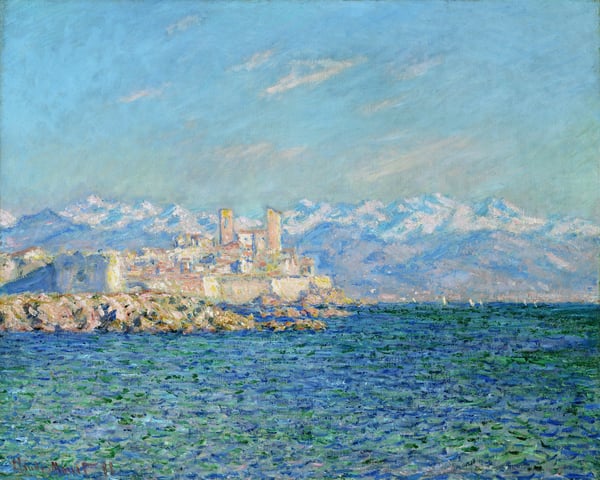
Deskundige analyse van Antibes, Afternoon Effect van Claude Monet
Stijl: Impressionism · Genre: landscape
Expert Analysis: "Antibes, Afternoon Effect" by Claude Monet
In Antibes, Afternoon Effect, Claude Monet demonstrates the quintessential Impressionist ambition—to capture a fleeting moment of light and atmosphere. Painted in 1888 during his stay on the French Riviera, this landscape marks a significant shift in Monet’s color palette and compositional approach compared to his earlier works.
What Makes It Significant within Impressionism:
-
Radical Treatment of Light and Color
Monet abandons local color in favor of a luminous, high-key palette dominated by pinks, lavenders, and deep blues. The “afternoon effect” is not merely a title but the subject itself: the sun’s angle creates sharp contrasts between warm sunlit surfaces (the pinkish fortress walls) and cool violet shadows. This optical analysis—treating light as the primary reality—exemplifies Impressionism’s break from academic conventions. -
Atmospheric Perspective and Brushwork
The painting employs loose, broken brushstrokes that dissolve forms into shimmering patches of pigment. The fortified town of Antibes appears almost weightless, merging with the sky and sea. Monet deliberately softens the horizon line, using reciprocal touches of blue and orange to evoke the shimmering heat haze. This technique—applying complementary colors side by side—makes the canvas vibrate with optical mixing. -
Regional and Thematic Shift
While early Impressionism focused on Paris and Normandy, Antibes, Afternoon Effect represents Monet’s expansion into southern France. Here, the strong Mediterranean light tested his ability to render intense chroma without losing atmospheric depth. The painting’s significance also lies in its series-like structure: Monet created a handful of Antibes views, each recording a different time of day, anticipating his later monumental series (Haystacks, Rouen Cathedral) that systematically explore changing light effects. -
Critical Reception and Legacy
When exhibited in 1889 alongside works by Rodin, this painting drew praise for its daring intensity. Critics noted that Monet had “found a new sun” in the South. Today, it stands as a masterclass in how Impressionism evolved from recording everyday life to becoming a rigorous study of perception itself. The painting’s vibrant, almost abstract patches of color foreshadow Post-Impressionism and Fauvism, proving Monet’s enduring influence on modern art.
In summary, Antibes, Afternoon Effect is significant not only as a breathtaking Mediterranean vista but as a technical manifesto: it shows Monet dissolving matter into light, where the “afternoon effect” becomes more real than the stone walls of Antibes.
Visueel vergelijkbaar
20 werken met verwante compositie en kleurenpalet
The Bay of Antibes
Claude Monet
The Old Fort at Antibes
Claude Monet
The Castle in Antibes
Claude Monet
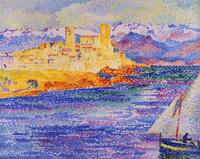
Antibes
Henri-Edmond Cross
Antibes, the Rocks of the Islet
Eugene Boudin
Antibes
Eugene Boudin
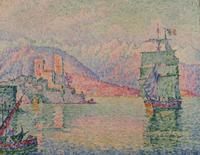
Antibes, Evening
Paul Signac
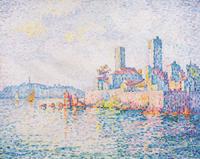
Antibes, the towers
Paul Signac
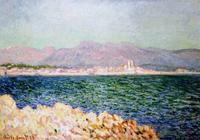
The Gulf of Antibes
Claude Monet
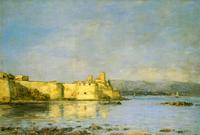
Antibes
Eugene Boudin
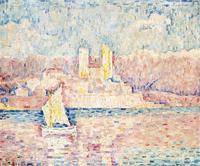
Cap d'Antibes
Paul Signac
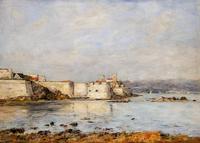
Antibes, the Fortifications
Eugene Boudin
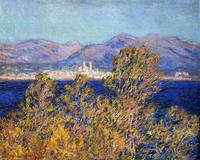
Antibes Seen from the Cape, Mistral Wind
Claude Monet
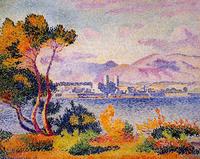
Antibes, Afternoon
Henri-Edmond Cross
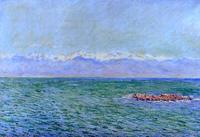
The Sea and the Alps
Claude Monet
Antibes, thunderstorms
Paul Signac
Morning Fog over the Port of Veer, Holland
Theo van Rysselberghe

Antibes Seen from the Salis Gardens 02
Claude Monet

View of Antibes from the Plateau Notre-Dame
Claude Monet
Fig Trees, Antibes
Guy Rose