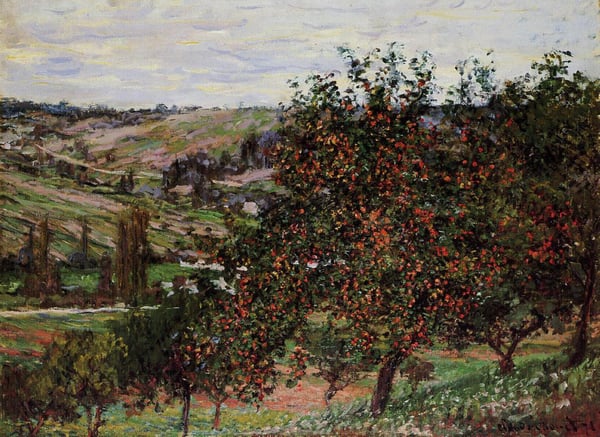
Deskundige analyse van Apple Trees near Vetheuil van Claude Monet
Stijl: Impressionism · Genre: landscape
Expert Analysis of "Apple Trees near Vetheuil" by Claude Monet
As a quintessential Impressionist landscape, Claude Monet's "Apple Trees near Vetheuil" exemplifies the movement's revolutionary approach to capturing light, atmosphere, and the transient effects of nature. Painted during one of Monet’s most productive periods while living in Vetheuil (a village northwest of Paris), the work demonstrates his commitment to plein air painting and the dissolution of form into pure color and light.
Significance within Impressionism:
-
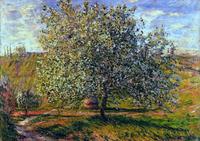
Emphasis on Light and Color over Subject – The titular apple trees are not rendered with crisp botanical detail; instead, Monet uses broken brushstrokes and a vibrant, high-key palette to convey the shimmering play of sunlight through leaves and across the orchard. The absence of black in shadows—replaced by blues, violets, and greens—is a hallmark of Impressionist color theory.
-
Capturing a Fleeting Moment – The composition suggests a particular time of day and weather condition, likely spring or early summer, when blossoms or foliage catch the changing sun. This ephemeral quality aligns with the Impressionist goal of recording the artist's immediate sensory perception.
-
Atmospheric Unity – Monet integrates the trees, sky, and ground through a unified treatment of light. The sky is not a static backdrop but a dynamic field of color that reflects onto the foliage and grass, creating a cohesive, all-over surface pattern that dissolves traditional foreground/background hierarchy.
-
Vetheuil as a Turning Point – Following the death of his first wife, Camille, in 1879, Monet retreated to Vetheuil, where he produced a series of landscapes that mark a shift toward a more systematic investigation of serial motifs (later culminating in his Haystacks and Rouen Cathedral series). Apple Trees near Vetheuil thus represents a bridge between his early pure Impressionism and his later focus on repetitive studies of light.
By emphasizing perceptual truth over descriptive accuracy, this painting stands as a key example of how Impressionism liberated the landscape genre from narrative and idealization, focusing instead on the sensory experience of nature under ever-changing light.
Visueel vergelijkbaar
20 werken met verwante compositie en kleurenpalet
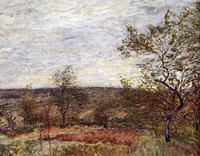
Windy Day At Veneux
Alfred Sisley
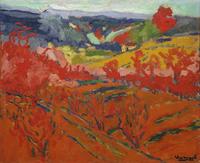
Autumn Landscape
Maurice de Vlaminck
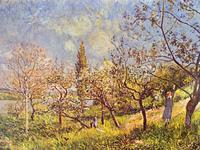
Orchard in spring
Alfred Sisley
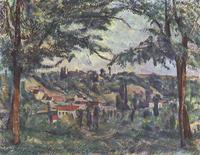
Landscape
Paul Cezanne
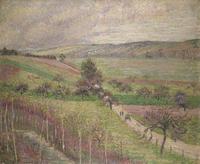
The Thierceville Road, Early Spring
Lucien Pissarro
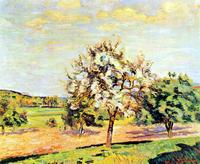
Pommiers en fleurs
Armand Guillaumin
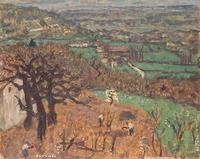
Dauphine Landscape
Pierre Bonnard
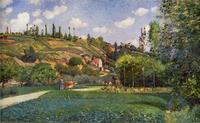
A Cowherd on the Route de Chou, Pontoise
Camille Pissarro
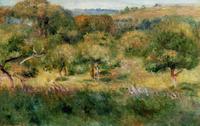
The Edge of the Forest in Brittany
Pierre-Auguste Renoir
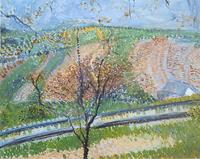
Railway to the Kahlenberg
Richard Gerstl
Field at Eragny
Camille Pissarro
Apple-Trees in Blossom
Paul Gauguin
Landscape
Theodore Robinson
Vetheuil, Flowering Plum Trees
Claude Monet
March Sun, Pontoise
Camille Pissarro
Landscape near Grasse
John Singer Sargent
Tree in Flower near Vetheuil
Claude Monet
Near Montmagny
Maurice Utrillo
Landscape of the Jas de Bouffan
Paul Cezanne
After the Rain, Autumn, Eragny
Camille Pissarro