
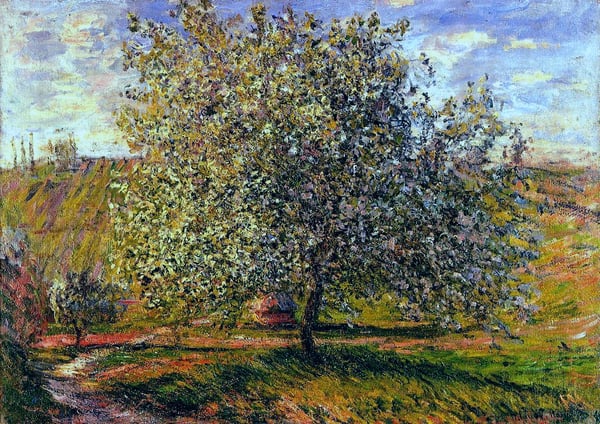
Expert analysis of Claude Monet’s Tree in Flower near Vetheuil
Style: Impressionism · Genre: landscape
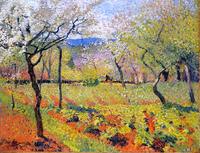
As an expert art historian, I offer the following analysis of Claude Monet's Tree in Flower near Vetheuil, a quintessential Impressionist landscape.
Significance in the Context of Impressionism
Monet's Tree in Flower near Vetheuil exemplifies the core Impressionist ambition: to capture the fleeting, sensory experience of a specific moment. Painted during his residence in the village of Vetheuil (1878–1881), this work is significant for its radical treatment of light and color. Rather than delineating the tree as a solid, botanical object, Monet dissolves its form into a shimmering array of broken brushstrokes and vibrant hues. The blossoms are not painted as individual flowers but as dabs of pink, white, and soft yellow, reflecting how the eye perceives a mass of petals in sunlight—a blur of pure, luminous color. The sky and foliage are similarly built from short, visible strokes, creating a unified optical vibration across the canvas.
This approach is a direct challenge to academic painting of the time, which demanded smooth finish and clear form. Instead, Monet prioritizes the atmospheric envelope—the way light interacts with air, water, and reflective surfaces. The tree’s blossoms become a study in the play of warm sunlight versus cooler shadows, with touches of blue and lavender suggesting the ambient light of a spring day. In this sense, the work is not simply a portrait of a tree, but a record of the sensation of seeing it at a particular hour.
Artistic and Historical Significance
Within Monet’s own oeuvre, Tree in Flower near Vetheuil belongs to a period of intense experimentation. Having fled poverty and the death of his wife Camille, Monet found a new creative energy in the rural landscapes around Vetheuil. Works from this period show him refining the techniques that would culminate in his later series paintings (e.g., Haystacks, Rouen Cathedral). The tree motif here anticipates his obsession with capturing how the same subject transforms under changing light conditions.
Aesthetically, the painting is significant for its balance of structure and spontaneity. The trunk and branches provide a gentle, asymmetrical anchor, while the surrounding atmosphere seems to blur the boundary between solid forms and their reflections. This tension between object and environment is a hallmark of high Impressionism. Today, the work stands as a masterful example of how Monet translated the ephemeral beauty of nature into a permanent, visceral experience for the viewer—a celebration of spring’s fleeting brilliance.
Visually similar
20 works with related composition and palette
Apple Trees in Bloom at Giverny
Claude Monet
Pommiers en fleurs
Armand Guillaumin
Apple Trees in Bloom
Claude Monet
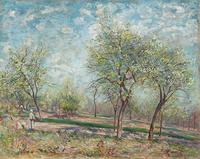
Apple Trees in Bloom
Alfred Sisley
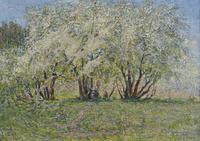
Rest under the bird cherry
Mikhail Olennikov
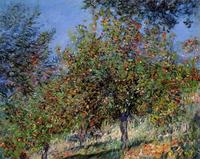
Apple Trees on the Chantemesle Hill
Claude Monet
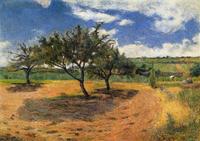
Apple-Trees in Blossom
Paul Gauguin
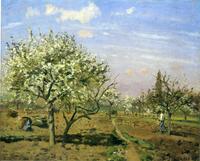
Orchard in Blossom, Louveciennes
Camille Pissarro
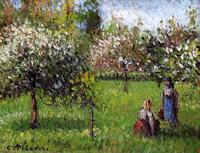
Apple Blossoms, Eragny
Camille Pissarro
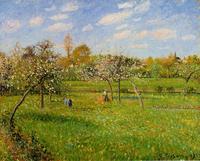
Spring Morning, Cloudy, Eragny
Camille Pissarro
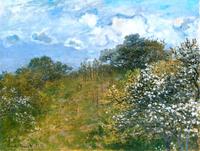
Springtime
Claude Monet
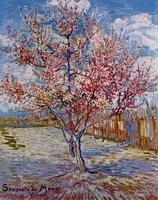
Peach Tree in Bloom (in memory of Mauve)
Vincent van Gogh
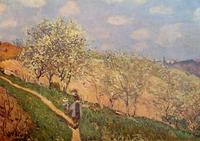
Spring in Bougival
Alfred Sisley
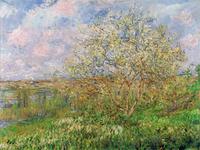
Springtime
Claude Monet
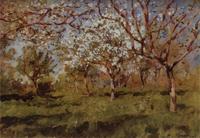
Apple trees in blossom
Isaac Levitan
Morning, Flowering Apple Trees, Eragny
Camille Pissarro
Plums Blossom
Claude Monet
Trees in Bloom
Claude Monet
Brides walk under the apple trees
Henri Martin
Flowering Garden in Spring
Henri Martin