Deskundige analyse van Apple Trees on the Chantemesle Hill van Claude Monet
Stijl: Impressionism · Genre: landscape
Expert Analysis of "Apple Trees on the Chantemesle Hill" by Claude Monet
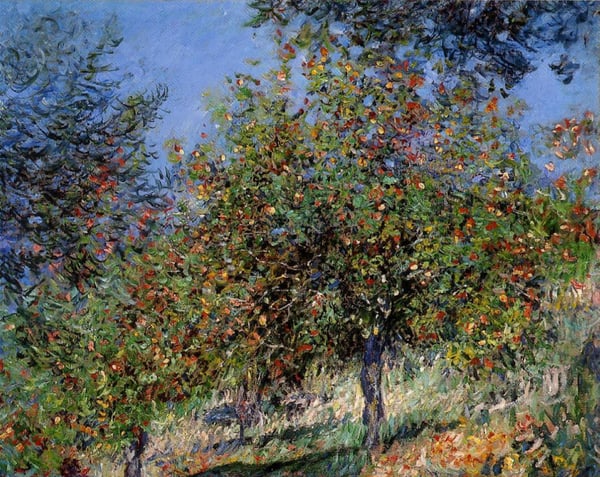
This landscape, painted by Claude Monet in the late 1880s, exemplifies the core tenets of Impressionism while highlighting a pivotal shift in the artist’s approach to capturing nature. Set on the hills near his home in Giverny, the work depicts a stretch of apple trees in bloom, their forms dissolving into the vibrant interplay of light and atmosphere.
Significance within Impressionism
-
Mastery of Transient Light and Atmosphere: Monet’s signature is the rendering of fleeting optical effects. Here, the dappled sunlight filtering through the apple blossoms and the soft haze of the Chantemesle hill create a shimmering, almost woven surface. The trees are not merely botanical subjects; they become vessels for color, with whites, pinks, greens, and pale blues broken into short, brisk strokes. This technique prioritizes the sensation of a moment—the warmth of spring light, the slight breeze moving the leaves—over rigid form.
-
Plein Air Directness: Like many Impressionist landscapes, this painting was executed outdoors (en plein air). The hill of Chantemesle, overlooking the Seine valley, was a favorite motif for Monet. The composition feels immediate and unposed, as if the artist stood amid the orchard, responding to the shifting conditions. The lack of a central focal point, combined with the cropped edges (the trees lead the eye out of the frame), reinforces the sense of a natural, unarranged view—a snapshot of perception.
-
Color as Structure: Monet dissolves the solidity of the trees and the hill through high-key color and complementary contrasts. The pale violet shadows beneath the trees and the blue-green of the distant hills (rendered in thin washes) counterbalance the warm whites and pale pinks of the blossoms. This color logic—rather than linear perspective—creates depth. The horizon is softened by atmospheric perspective, a hallmark of Impressionist landscapes that sought to capture the air itself.
-
Serial Sensitivity: While Monet is most famous for his later series (Haystacks, Rouen Cathedral, Water Lilies), this painting belongs to a group of orchard scenes he painted in the 1880s. It demonstrates his growing obsession with the same subject under varied conditions—here, the apple trees in blossom announce the arrival of spring, a theme of renewal that recurs throughout his work. The painting is therefore a precursor to his serial approach, where the motif is merely a pretext for studying light’s transformations.
Artistic Impact
"Apple Trees on the Chantemesle Hill" is significant as a transitional work. It retains the brisk, spontaneous brushwork of early Impressionism but already hints at the more decorative, flattened space that would emerge in Monet’s later Giverny paintings. The apple trees, with their repetitive vertical forms and soft edges, create a rhythmic pattern across the canvas—a musical quality that anticipates the abstracting impulses of Post-Impressionism and even early Modernism.
In sum, this painting is not merely a charming orchard scene. It is a concentrated study in how color and light can dissolve matter into atmosphere, a celebration of the ephemeral beauty of spring, and a key example of Monet’s lifelong effort to capture the “instantaneity” that defines Impressionism at its most radical.
Visueel vergelijkbaar
20 werken met verwante compositie en kleurenpalet
The Pear Tree
Pierre-Auguste Renoir
Giverny in Springtime
Claude Monet
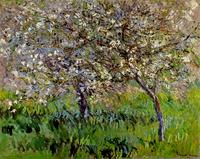
Apple Trees in Bloom at Giverny
Claude Monet
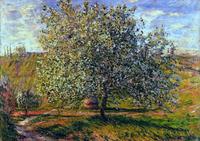
Tree in Flower near Vetheuil
Claude Monet
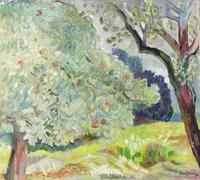
Apple Tree, Late Summer
Karl Schrag
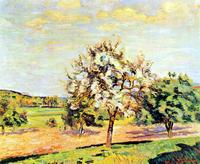
Pommiers en fleurs
Armand Guillaumin
Orchard in spring
Alfred Sisley
Under the Lemon Trees
Claude Monet
Woman in White in the Garden at Colettes
Pierre-Auguste Renoir
Spring in Crimea
Isaac Levitan
Woman under a Tree
Pierre-Auguste Renoir
Apple Trees in Bloom
Alfred Sisley
The Olive Tree Wood In The Moreno Garden
Claude Monet
Landscape at Grasse
Pierre-Auguste Renoir
The Oak
Guy Rose
Corsican Landscape
Henri Matisse
Study for 'In the Woods with Female Nude
Henri-Edmond Cross
Belkino. Garden.
Pyotr Konchalovsky
Spring at Veneux
Alfred Sisley
Apple trees in blossom
Isaac Levitan