
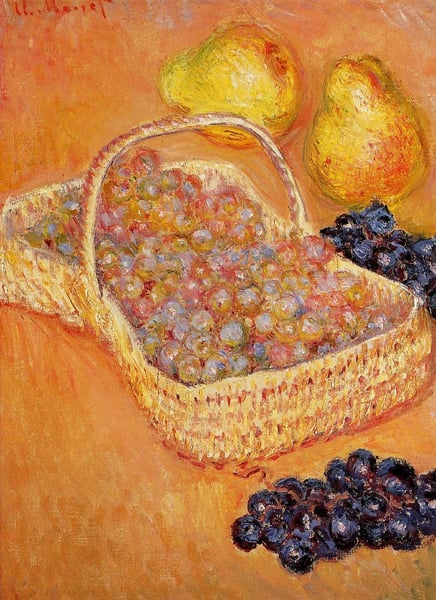
Expert analysis of Claude Monet’s Basket of Graphes, Quinces and Pears
Style: Impressionism · Genre: still life
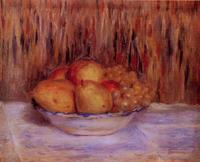
Expert Analysis: "Basket of Grapes, Quinces and Pears" by Claude Monet
Stylistic Significance
As an Impressionist still life, this work exemplifies the movement’s radical departure from the meticulously rendered, symbol-laden still lifes of the academic tradition. Monet applies the core Impressionist principles—capturing the fleeting effects of light and atmosphere—to a domestic subject. Instead of polished, illusionistic detail, the painting is built from rapid, visible brushstrokes that model the fruits through color and light rather than line. The basket, grapes, quinces, and pears are not static objects but vibrant patches of hue that shimmer under a specific, atmospheric moment.
Genre Innovation
While Impressionism is most celebrated for its landscapes and scenes of modern life, Monet’s still lifes are crucial to understanding the movement’s scope. This painting challenges the hierarchy of genres (which placed history painting above still life) by granting humble fruit the same painterly attention as a cathedral or haystack. The composition likely employs a tilted tabletop and cropped edges—devices borrowed from Japanese prints and photography—to create an immediate, intimate viewpoint that feels spontaneous rather than posed.
Color and Light
Monet’s palette here would be characterized by broken color: complementary hues (e.g., green grapes against red-violet shadows) that the viewer’s eye mixes optically. The quinces and pears are not a uniform yellow or green but a mosaic of blues, oranges, and whites that suggest the play of light on their surfaces. This treatment dissolves solid forms into vibrations of color, making the still life a study of perception itself—a hallmark of Impressionist significance.
Legacy
Within Monet’s oeuvre, this still life demonstrates his lifelong obsession with light’s mutability, even in a contained, indoor setting. It bridges his early, more traditional works and his later series paintings, showing how he applied atmospheric observation to any subject. For Impressionism as a whole, this painting affirms that the movement’s innovations—optical color mixing, broken brushwork, and a focus on transient effects—were not limited to open-air scenes but could transform even the most conventional genre into a radical statement about how we see.
Visually similar
20 works with related composition and palette
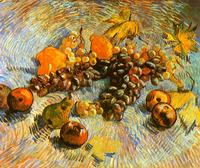
Still Life with Apples, Pears, Lemons and Grapes
Vincent van Gogh
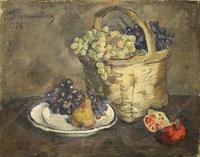
Still Life. Grapes and pomegranates.
Pyotr Konchalovsky
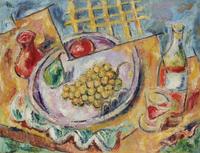
Still Life With Fruits
Corneliu Michailescu
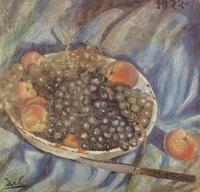
Still Life
Salvador Dali
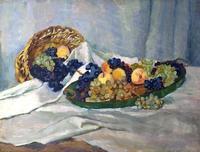
Still Life
Gohar Fermanyan
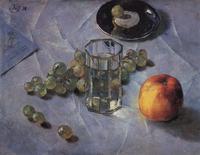
Grapes
Kuzma Petrov-Vodkin
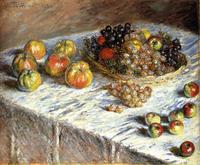
Still Life with Apples And Grapes
Claude Monet
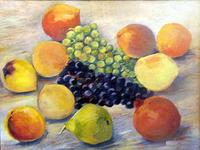
Still life
Martiros Sarian
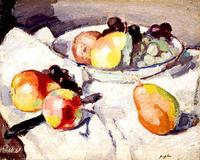
Still Life, Pears and Grapes
Samuel Peploe
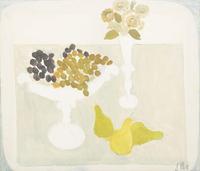
Pears and Grapes
Constantin Piliuta
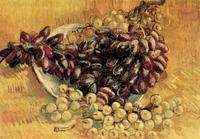
Still Life with Grapes
Vincent van Gogh
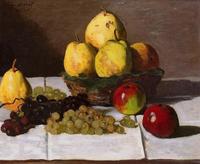
Still Life with Pears and Grapes
Claude Monet
Still Life
Theophrastos Triantafyllidis
Peaches and Grapes
Henri Fantin-Latour
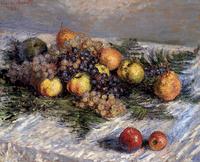
Still Life with Pears and Grapes
Claude Monet
Still-life with grapes
Minas Avetisyan
Basket of White Grapes and Peaches
Henri Fantin-Latour
Grapes and apples
Kuzma Petrov-Vodkin
Still Life Apples and Grapes
Henri Fantin-Latour
Still Life with Pears and Grapes
Pierre-Auguste Renoir