
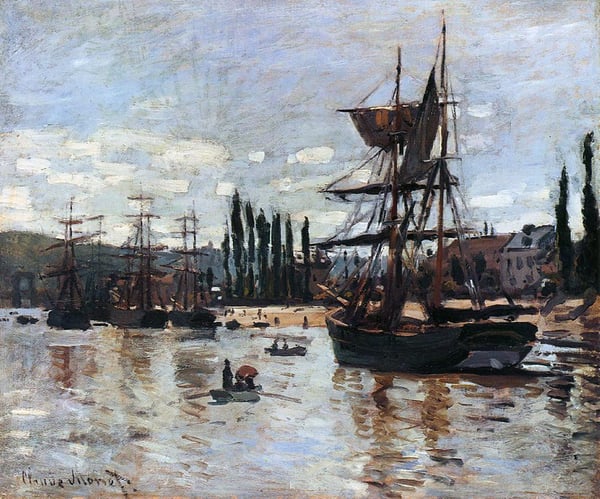
Expert analysis of Claude Monet’s Boats at Rouen
Style: Impressionism · Genre: cityscape
Expert Analysis: "Boats at Rouen" by Claude Monet
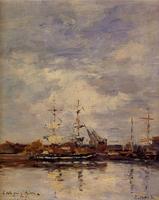
Claude Monet’s "Boats at Rouen" stands as a quintessential example of Impressionism applied to the cityscape genre, demonstrating the movement’s radical break from academic tradition. Painted during one of Monet’s extended visits to the bustling port city on the Seine, the work captures the industrial and commercial life of Rouen through the lens of fleeting atmospheric effects—a hallmark of the Impressionist ethos.
Significance within Impressionism:
-
Emphasis on Light and Atmosphere over Detail
Monet dissolves the solid forms of boats, docks, and the distant skyline into a shimmering tapestry of broken brushstrokes. The water’s surface becomes a mirror of shifting hues—blues, greens, purples, and hints of orange—reflecting the changing light at a specific moment. This prioritization of optical sensation over precise outlines is central to Impressionism’s revolutionary approach. -
Modern Urban Subject Treated with Lyrical Grace
By choosing a working port rather than a pastoral landscape, Monet elevates the everyday cityscape to high art. The boats, smoke, and water are not just objects but vehicles for studying color relationships and the interplay between natural and artificial elements. This aligns with Impressionism’s focus on contemporary life, revealing beauty in transient industrial scenes. -
Serial Exploration of a Single Motif
Although best known for his Rouen Cathedral series, Monet also painted multiple views of the city’s harbor and the Seine. Boats at Rouen likely belongs to this broader serial approach, where the same subject is revisited under different weather and light conditions. This practice underscores the Impressionist belief that reality is not fixed but perpetually changing, and that the artist’s task is to capture a unique, ephemeral instant. -
Dynamic Brushwork and Color Harmony
The painting’s significance lies in its audacious technique: rapid, visible strokes of pure color mix optically on the canvas rather than in advance. The result is a vibrant, almost vibrating surface that conveys the rippling water and the bustle of port activity. Monet’s use of complementary colors (e.g., warm yellows against cool blues) enhances luminosity, making the scene feel bathed in fresh air and sunlight.
Conclusion: Boats at Rouen is a masterful demonstration of Impressionism’s core principles—absolute fidelity to the artist’s perceptual experience, the celebration of modern urban life, and the transformation of ordinary motifs into symphonies of light and color. It exemplifies how Monet pushed the boundaries of representation, influencing generations of painters to see the world not as static objects but as fluid, sensory phenomena.
Visually similar
20 works with related composition and palette
The Canal at Saint-Valery-sur-Somme
Eugene Boudin
Camaret, Boats on the Shore
Eugene Boudin
Ships at Le Havre
Eugene Boudin
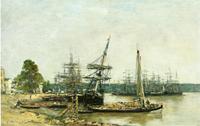
Bordeaux
Eugene Boudin
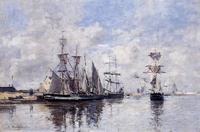
The Port of Deauville
Eugene Boudin
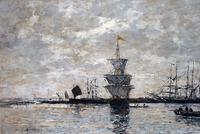
Le Havre Sun
Eugene Boudin
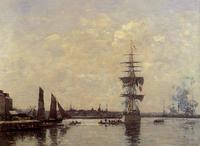
Sailing Boats at Quay
Eugene Boudin
A Parade of Boats
Childe Hassam
Sailing Boats at Anchor
Eugene Boudin
Near Rotterdam
Eugene Boudin
The Deauville Basin
Eugene Boudin
Le Havre. Avent Port.
Eugene Boudin
Deauville, the Harbor
Eugene Boudin
The Port of Trouville, High Tide
Eugene Boudin
The Seine Below Rouen
Claude Monet
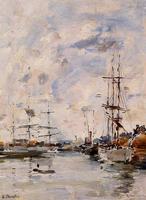
The Deauville Basin
Eugene Boudin
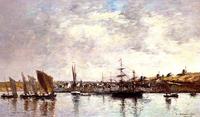
Camaret, the Port
Eugene Boudin
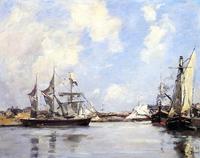
Deauville, the Port
Eugene Boudin
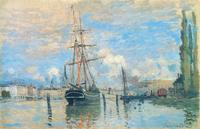
The Seine at Rouen
Claude Monet
Deauville Harbor
Eugene Boudin