
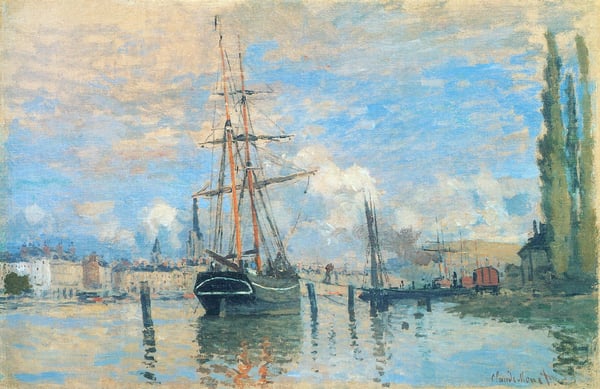
Analisi esperta di The Seine at Rouen di Claude Monet
Stile: Impressionism · Genere: cityscape
Expert Analysis: The Seine at Rouen by Claude Monet
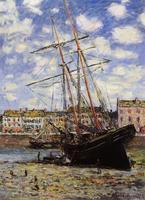
Claude Monet’s The Seine at Rouen is a quintessential Impressionist cityscape that exemplifies the movement’s revolutionary approach to capturing light, atmosphere, and the fleeting passage of time. Painted during the 1870s–1880s, when Monet was deeply engaged with the River Seine as a subject, this work transforms a seemingly ordinary urban waterfront into a shimmering study of chromatic vibration and perceptual immediacy.
Significance within Impressionism: Monet’s treatment of the Seine at Rouen breaks decisively from academic landscape conventions. Instead of defining solid forms with precise outlines, he builds the scene from rapid, broken brushstrokes that seem to dance across the canvas. The water’s surface is rendered as a mosaic of blues, greens, purples, and pale yellows—reflections of the sky and the city’s architecture are dissolved into pure color patches. The cathedral spires and factory chimneys on the horizon are not delineated but suggested through tonal contrasts and soft edges, merging the man‑made with the natural in a unified atmosphere.
Artistic Innovations:
- Optical mixing: Monet juxtaposes complementary colors (e.g., orange and blue in the sky and water) so that the viewer’s eye blends them at a distance, producing a vibrant, luminous effect that standard mixing could not achieve.
- Capture of momentary conditions: The painting’s palette and brushwork indicate a specific time of day—likely late afternoon—when the sun casts warm, broken light across the river. The rippling reflections shimmer as if in constant motion, embodying the Impressionist credo of rendering “the instantaneity” of perception.
- Modern subject matter: Unlike idealized classical cityscapes, Monet depicts Rouen as a living, industrial port. Boats, smoke, and bridges are integrated into the lyrical play of light, celebrating modern urban life without moralizing or sentimentality.
Why It Matters: This work is significant not only for its technical bravura but also for its role in the evolution of serial painting. Monet would later famously paint Rouen Cathedral dozens of times to study changing light, but The Seine at Rouen already shows his obsession with repeating a motif under different atmospheric conditions. It anticipates the radical abstraction of his later Water Lilies and Haystacks series, where the subject becomes a mere vehicle for pure optical sensation.
In summary, The Seine at Rouen is a landmark of Impressionism: a cityscape that dissolves stone and water into a symphony of color, a testament to Monet’s belief that “the motif is secondary… what I want to reproduce is what exists between the motif and me.”
Visivamente simili
20 opere con composizione e palette affini
The Havre, the trade bassin
Claude Monet
Le Havre. Avent Port.
Eugene Boudin
The Sea, Port in Amsterdam
Claude Monet
The Basin at Deauville
Eugene Boudin
Harbour at Camaret
Eugene Boudin
The Port at Deauville
Eugene Boudin
Sailing Boats at Quay
Eugene Boudin
The Port, Fecamp
Eugene Boudin
Sailing Boats
Eugene Boudin
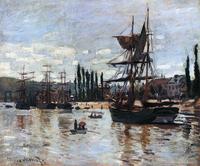
Boats at Rouen
Claude Monet
Portrieux
Eugene Boudin
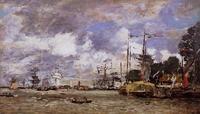
Antwerp, Boats on the River Escaut
Eugene Boudin
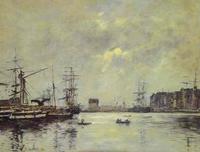
The Port of Le Havre (Dock of La Barre)
Eugene Boudin
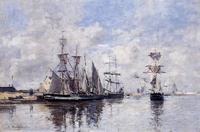
The Port of Deauville
Eugene Boudin
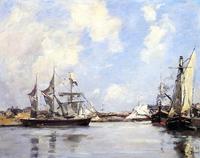
Deauville, the Port
Eugene Boudin
The Bridge over the Toques at Trouville
Eugene Boudin
Near Rotterdam
Eugene Boudin
The Sea at Amsterdam
Claude Monet
The Deauville Basin
Eugene Boudin
Boat at Low Tide at Fecamp
Claude Monet