Expert analysis of Claude Monet’s Branch of Orange Bearing Fruit
Style: Impressionism · Genre: still life
Expert Analysis: "Branch of Orange Bearing Fruit" by Claude Monet
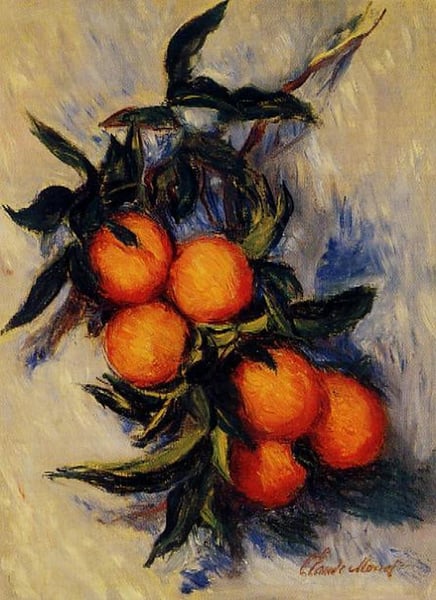
As an Impressionist still life, Monet’s Branch of Orange Bearing Fruit represents a pivotal departure from the strict, symbolic still-life traditions of the 19th century. While Monet is celebrated for his atmospheric landscapes and series of haystacks and water lilies, this work demonstrates how he applied the same radical principles—optical color mixing, broken brushwork, and an emphasis on fleeting light—to a humble, indoor subject.
Significance within Impressionism
-
Rejection of Academic Still Life
Traditional still lifes favored meticulous detail, chiaroscuro, and symbolic meaning (e.g., vanitas). Monet instead treats the orange branch as a vehicle for capturing the momentary impression of light falling on its leaves and fruit. The brushstrokes are visible and energetic, dissolving solid forms into patches of color that resolve only when viewed at a distance. -
Focus on Color and Atmosphere
The painting likely prioritizes subtle tonal variations – the interplay of warm orange, green, and reflected light – over local color. Monet’s use of complementary hues (e.g., orange against blue-grey shadows) creates a vibrant, almost shimmering effect, as if the branch is caught in a specific time of day. This transience is the core of Impressionist philosophy. -
Expansion of Impressionist Subject Matter
While Impressionism is often associated with outdoor scenes, Monet’s still lifes prove that the same principles apply indoors. The branch is likely isolated against a plain background, forcing the viewer to focus solely on the painterly handling of light and texture—a precursor to his late, nearly abstract works like the Nymphéas.
Legacy
Branch of Orange Bearing Fruit is significant because it blurs the boundary between still life and landscape. The branch, perhaps cut from a tree in his garden, connects the interior realm of the studio with the natural world. In doing so, Monet transforms a simple, everyday object into a luminous study of perception, reinforcing Impressionism’s radical assertion that art should record the artist’s sensory experience in the moment.
Visually similar
20 works with related composition and palette
Still Life
Pierre-Auguste Renoir
Seville oranges
Nikolaos Lytras
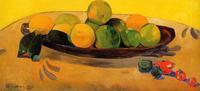
Still life with Tahitian oranges
Paul Gauguin
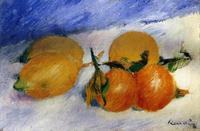
Still Life with Lemons and Oranges
Pierre-Auguste Renoir
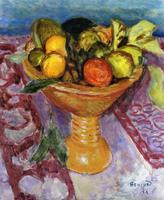
Fruit Bowl
Pierre Bonnard
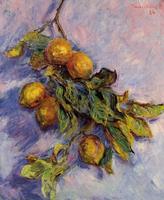
Branch of Lemons
Claude Monet
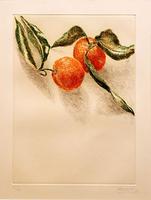
Tangerines
Avigdor Arikha
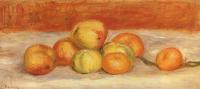
Apples and Manderines
Pierre-Auguste Renoir
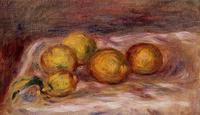
Lemons
Pierre-Auguste Renoir
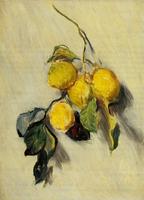
Branch of Lemons
Claude Monet
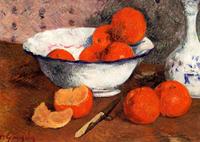
Still life with Oranges
Paul Gauguin
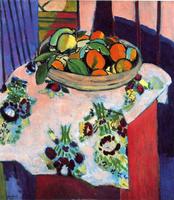
Basket with Oranges
Henri Matisse
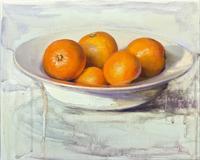
Naranjas
Luis Álvarez Roure
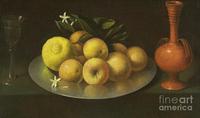
Still Life with Glass, Fruit, and Jar
Francisco de Zurbaran
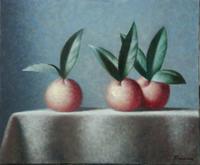
Untitled
Sergey Belik
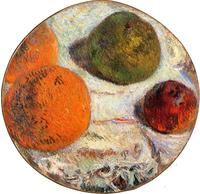
Fruit
Paul Gauguin
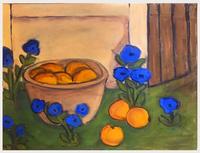
Fruit and Flowers 1987
Jay Norman
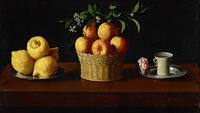
Still Life
Francisco de Zurbaran
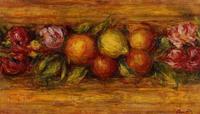
Garland of Fruit and Flowers
Pierre-Auguste Renoir
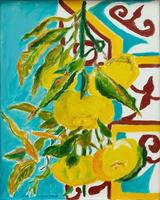
Arabesque 40 X 30 Cm 2016
Susanne Kamps