Expert analysis of Claude Monet’s By the River at Vernon
Style: Impressionism · Genre: cityscape
Expert Analysis: "By the River at Vernon" by Claude Monet
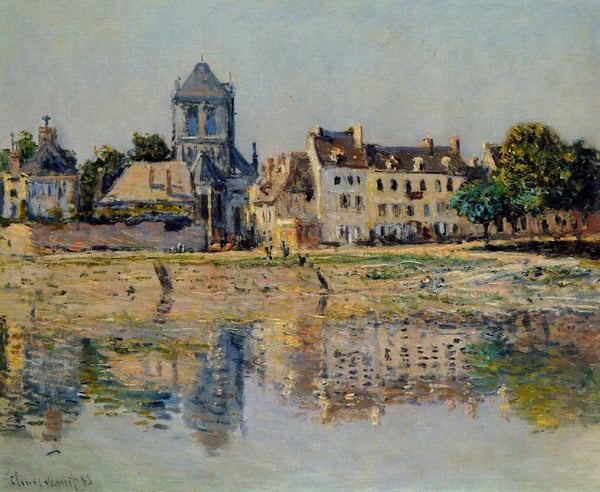
As an Impressionist cityscape, Claude Monet’s By the River at Vernon exemplifies the movement’s radical break from academic tradition through its focus on transient light, atmospheric color, and the integration of urban and natural elements. Painted during a period when Monet frequently explored the Seine River valley, the work captures the small town of Vernon (near his home in Giverny) not as a static topographic record, but as a shimmering, sensory experience.
Significance within Impressionism:
- Light and Atmosphere: Monet dissolves architectural and natural forms into patches of broken, vibrating color, emphasizing how sunlight on water and mist softens contours. The river’s reflections and the distant town’s silhouette are rendered with rapid, visible brushstrokes—a hallmark of Impressionist plein air practice.
- Cityscape as Lived Moment: Unlike traditional cityscapes that prioritized precise detail (e.g., architectural renderings), Monet’s view treats the town as part of a living, fleeting ambiance. The blurring of riverbanks, trees, and buildings suggests the interplay of air, water, and light, making the ordinary scene feel ephemeral.
- Color Theory: Monet uses complementary hues (cool blues and greens against warm ochres and pinks) to create optical vibrancy. The sky and water are not merely background but active, luminous surfaces that unify the composition.
Artistic Context:
Painted during Monet’s mature period, By the River at Vernon reflects his serial approach to nature—similar to his Haystacks or Rouen Cathedral—but here applied to a less monumental subject. The work demonstrates how Impressionism elevated everyday scenery to high art, prioritizing perception over narrative. Monet’s subtle treatment of the urban fringe (the riverfront town) also anticipates his later, more abstract water-lily studies, where reflection and reality merge.
In summary, this painting is significant because it captures the core Impressionist ambition: to record how a place feels at a specific moment, using color and brushwork as vehicles for pure optical sensation, rather than objective description.
Visually similar
20 works with related composition and palette
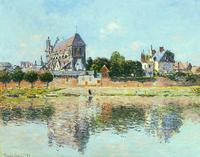
View of the Church at Vernon
Claude Monet
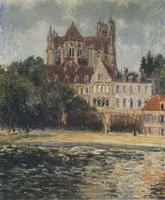
The Auxerre Cathedral
Gustave Loiseau
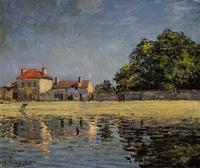
Banks of the Loing, Saint Mammes
Alfred Sisley
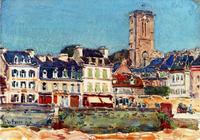
The Quai, Lannion
Childe Hassam
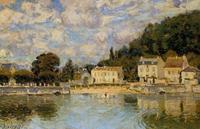
Horses being Watered at Marly le Roi
Alfred Sisley
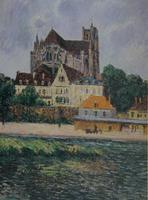
The Auxerre Cathedral
Gustave Loiseau
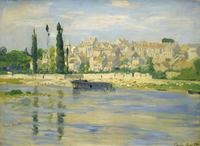
Carrieres-Saint-Denis
Claude Monet
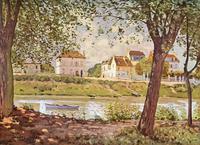
Village on the banks of the Seine
Alfred Sisley
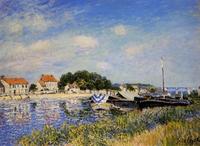
Banks of the Loing at Saint Mammes
Alfred Sisley
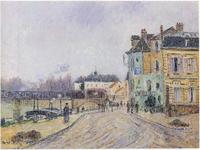
Quay on Oise in Pontoise
Gustave Loiseau
Village Street Grey Weather
Alfred Sisley
The Port of Trouville
Eugene Boudin
The Auxerre Cathedral
Gustave Loiseau
Trouville
Eugene Boudin
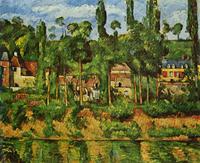
The Chateau de Medan
Paul Cezanne
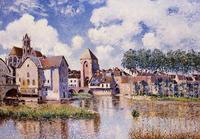
Moret sur Loing the Porte de Bourgogne
Alfred Sisley
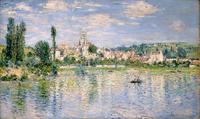
Vetheuil in Summer
Claude Monet
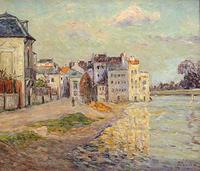
The Embankment of Lagny under Flood Water
Maxime Maufra
Saint Mammes
Alfred Sisley
Moret Sur Loing
Alfred Sisley