
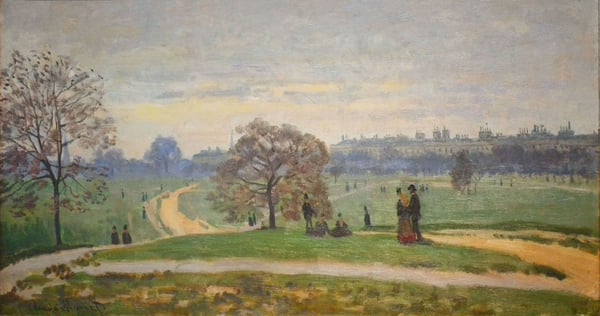
Expertenanalyse zu Claude Monets Hyde Park
Stil: Impressionism · Genre: landscape
Expert Analysis: "Hyde Park" by Claude Monet (Impressionism, Landscape)
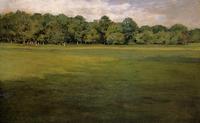
Claude Monet’s Hyde Park epitomizes the Impressionist quest to capture fleeting atmospheric conditions and the ephemeral play of light. Though the scene depicts a familiar London landmark, Monet transforms it into a shimmering tapestry of color and sensation rather than a topographical record.
Significance within Impressionism
This work belongs to Monet’s London series (c. 1900–1901), during which he painted the Thames and its parks from hotel windows and vantage points. Unlike earlier Impressionist cityscapes (e.g., Pissarro’s boulevards), Monet here focuses less on the park’s identifiable features—its trees, pathways, or the Serpentine—than on the enveloping fog and the way it dissolves forms. The hazy, luminous atmosphere is the true subject: mist softens edges, mutes contrasts, and creates a near-monochrome palette of silvery blues, muted greens, and pale golds. This aligns with Monet’s later obsession with serial treatments of the same motif under varying light (e.g., Haystacks, Rouen Cathedral).
Artistic techniques of note
- Loose, broken brushwork: Monet applies paint in short, comma-like dabs, capturing the shimmer of damp air and the dappled quality of filtered sunlight. The trees and figures are suggested rather than delineated, inviting the viewer’s eye to blend colors optically.
- Atmospheric perspective: The background fades into a soft haze, typical of Monet’s London views. This technique emphasizes the pervasive fog, a signature of London’s industrial-era climate.
- Limited but nuanced palette: Dominated by cool tones (blue, gray, violet) warmed by occasional touches of yellow or pink, the painting evokes a specific early-morning or late-afternoon light, when the sun struggles through the mist.
Why it matters
Hyde Park demonstrates how Impressionism evolved from depicting leisure activities (as in Monet’s earlier Bain à la Grenouillère) to exploring purely visual and sensory phenomena. It also reveals Monet’s influence on later movements: the near-abstract, colorful haze anticipates the color-field painters and the ethereal quality of J.M.W. Turner’s late work, which Monet deeply admired. In essence, the painting is not a portrait of a park but a study of how light, moisture, and distance can dissolve a scene into pure atmosphere—a core achievement of high Impressionism.
Visuell ähnlich
20 Werke mit ähnlicher Komposition und Farbpalette
Green Park in London
Claude Monet
Evening Game
Arthur Streeton
In the Luxembourg Gardens
Ethel Carrick
Primrose Hill, Regent's Park
Camille Pissarro
Kensington Gardens, London
Camille Pissarro
Chiswick Mall
Lucien Pissarro
Dieppe
Charles Conder
Landscape at Eragny
Camille Pissarro
Setting Sun, Autumn in Eragny
Camille Pissarro
After the Rain, Autumn, Eragny
Camille Pissarro
Near Sydenham Hill, Looking towards Lower Norwood
Camille Pissarro
The Oak Tree
Graham Bell
Landscape at Bazincourt
Camille Pissarro
Sunset with Fog, Eragny
Camille Pissarro
Road over the Hill
John Henry Twachtman
The Park at Sevres
Alfred Sisley
Blossom, Sun and Mist, Chipperfield, Hertfordshire
Lucien Pissarro
The Fields of Eragny, the Apple Tree
Camille Pissarro
Autumn, Morning Mist, Éragny-sur-Epte
Camille Pissarro
Prospect Park, aka Croquet Lawn Prospect Park
William Merritt Chase