
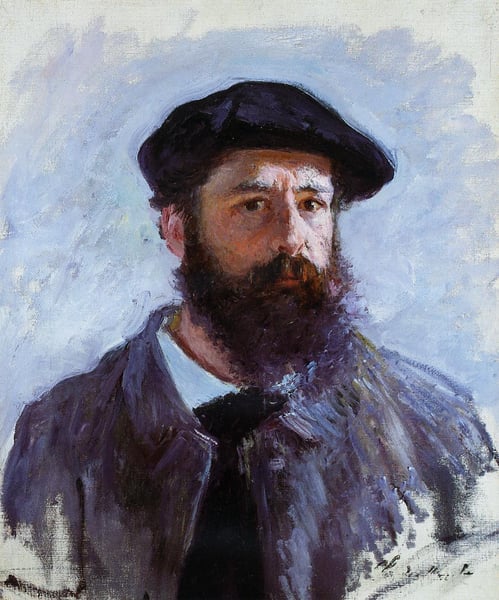
Expert analysis of Claude Monet’s Self-Portrait with a Beret
Style: Impressionism · Genre: self-portrait
Expert Art Historical Analysis: Claude Monet’s Self-Portrait with a Beret
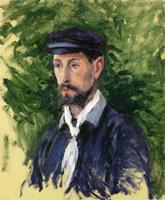
Claude Monet’s Self-Portrait with a Beret holds a distinctive place in the Impressionist canon, not only as a rare introspective work by a painter famed for landscapes but as a direct declaration of the artist’s identity and the movement’s core principles.
Significance within Impressionism
Unlike the spontaneous outdoor scenes for which Monet is revered, this self-portrait turns the Impressionist gaze inward. Yet it retains the hallmarks of the style: loose, visible brushwork that models the face through color and light rather than sharp line, and a focus on the fleeting moment of self-observation. The beret—a self-conscious sign of the artist’s persona—anchors the composition symbolically. By rendering himself in this traditional artist’s accessory, Monet aligns with the bohemian identity of the modern painter, even as his technique radically departs from academic portraiture.
Artistic Approach
Monet eschews precise detailing in favor of a tonal harmony built from rapid strokes of muted yet varied hues—grays, blues, ochres, and subtle pinks—that capture the play of light across his features. The background is deliberately simplified, nearly dissolving into atmosphere, which pushes the figure forward and emphasizes the psychological immediacy of the encounter. This is not a static likeness but a record of the painter’s material and perceptual process.
Context and Rarity
Monet produced very few self-portraits, making this work a crucial document for understanding his self-conception during the height of Impressionism. It demonstrates that the movement’s radical approach to perception could be applied not only to haystacks and cathedrals but to the most intimate subject: the artist himself. The painting thus bridges the public innovations of Impressionism with a private, almost meditative, reflection on the artist’s role as both subject and maker.
In summary, Self-Portrait with a Beret is significant as a rare instance of Monet turning his revolutionary technique onto his own image, asserting the Impressionist belief that even the self is a fluid, light-driven phenomenon—and that the artist’s identity is inseparable from the act of seeing.
Museum / Gallery
Visually similar
20 works with related composition and palette
Portrait of Eugene Manet (study)
Edgar Degas
Portrait of Poly, fisherman at Kervillaouen
Claude Monet
Portrait of Monsieur Louis Estruc
Camille Pissarro
Portrait of Achille Granchi Taylor
Paul Gauguin
Autoportrait
Henri Manguin
Self-Portrait in a Casquette
Paul Cezanne
Head of a Man
Ilya Repin
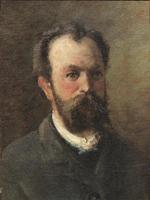
Male portrait
Noè Bordignon
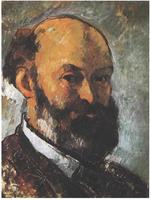
Self-Portrait
Paul Cezanne
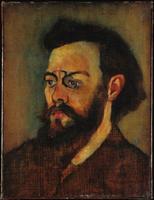
Bernard Lemaire
Suzanne Valadon
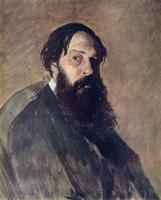
Portrait of the Painter Alexey Savrasov
Vasily Perov
The Internist Professor Samuel Stern
Anton Romako
Self Portrait
Georg Tappert
Self Portrait with a Palette
Edouard Manet
Federico Rubio y Gali
Alejandro Cabeza
Self-Portrait
John Singer Sargent
Self Portrait
Camille Pissarro
Self-portrait in front of pink background
Paul Cezanne
Portrait of Isidore Gauguin
Paul Gauguin
Bust Portrait of Eugene Lamy
Gustave Caillebotte