Expert analysis of Claude Monet’s The Beach at Fecamp
Style: Impressionism · Genre: landscape
Expert Analysis: The Beach at Fécamp by Claude Monet (Impressionism)
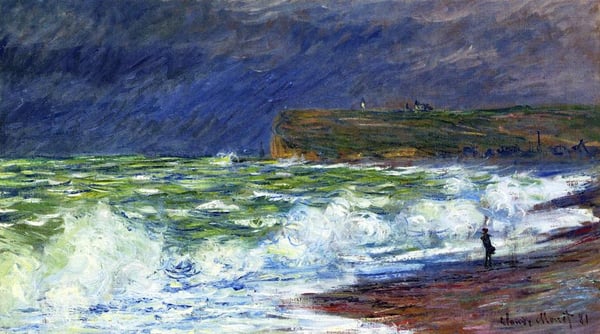
Claude Monet’s The Beach at Fécamp stands as a quintessential example of the Impressionist revolution in landscape painting. Executed during the 1880s—a period when Monet was intensely exploring the effects of light and atmosphere on the Normandy coast—this work captures a fleeting moment of coastal life with the signature broken brushwork and luminous palette that defined the movement.
Significance within Impressionism:
- Transient Light and Color: Rather than rendering a static, topographical view, Monet dissolves the shoreline into a shimmering tapestry of blues, greens, and sandy hues. The sky and sea merge through rapid, comma-like strokes, emphasizing the ever-changing quality of natural light—a core Impressionist tenet.
- Everyday Modernity: The choice of Fécamp, a working fishing port rather than a grand historical subject, reflects the Impressionist focus on contemporary life. The beach, dotted with small figures and boats, becomes a stage for mundane leisure and labor, elevating the ordinary to the sublime.
- Texture and Atmosphere: Monet’s thick impasto and visible brushwork convey the gritty feel of sand, the sparkle of water, and the dampness of sea air. This tactile approach invites the viewer to experience the sensation of being in the scene, not merely observing it.
What makes this work significant:
The Beach at Fécamp demonstrates Monet’s mastery of color theory and his break from academic conventions. By prioritizing optical truth over detailed representation, he creates an image that feels both immediate and eternal. This painting is a pivotal record of his ongoing series—though not as famous as his Rouen Cathedral or Water Lilies—it embodies the radical, sensory-driven ethos that would define Impressionism and influence generations of modernist painters.
Visually similar
20 works with related composition and palette
Stormy Seascape
Claude Monet
Seascape
Pierre-Auguste Renoir
Cliffs at Etretat
Lilla Cabot Perry
Receding Waves
Claude Monet
By the Sea
Maxime Maufra
The Wave
Roderic O'Conor
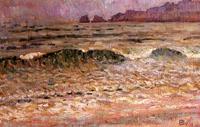
Rain Jersey
Theo van Rysselberghe
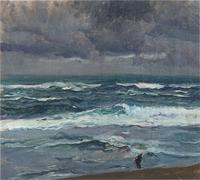
Seascape
Joaquín Sorolla
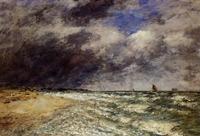
A Squall from Northwest
Eugene Boudin
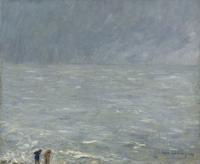
Trouville, la mer
Kees van Dongen
Cliff at Pourville
Claude Monet
Rough Sea at Etretat
Claude Monet
High Sea
Edward E. Simmons
Rough Sea
Claude Monet
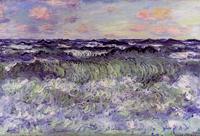
Sea Study
Claude Monet
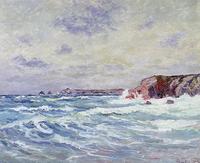
Port-Bara (Near the Ile de Quiberon)
Maxime Maufra
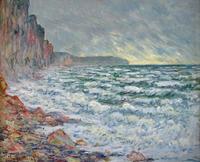
The Sea at Fecamp
Claude Monet
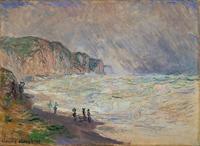
Heavy Sea at Pourville
Claude Monet
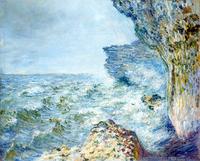
The Sea at Fecamp
Claude Monet
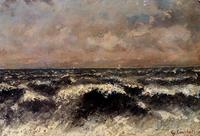
Seascape
Gustave Courbet