
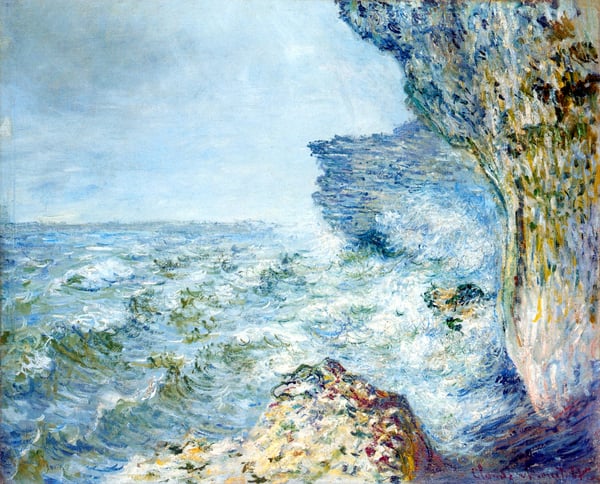
Analisi esperta di The Sea at Fecamp di Claude Monet
Stile: Impressionism · Genere: landscape
Expert Analysis: The Sea at Fecamp by Claude Monet
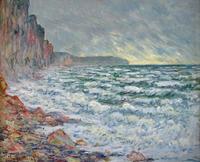
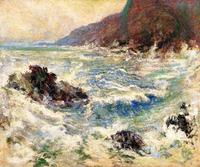
As a landscape executed in the Impressionist style, Claude Monet’s The Sea at Fecamp embodies the revolutionary principles that defined the movement. Impressionism sought to capture fleeting moments of light and atmosphere, and Monet’s treatment of the Normandy coastline at Fecamp is a quintessential example of this goal.
Significance Within Impressionism
-
Emphasis on Light and Atmospheric Conditions
Monet was less concerned with topographical exactitude than with the transient effects of sunlight, mist, and weather on the sea and shore. In The Sea at Fecamp, the artist likely employed a high-key palette—soft blues, greens, and touches of white—to convey the shimmering quality of the water and the hazy sky typical of the English Channel. The painting’s significance lies in how it prioritizes perception over description: the sea is not a static object but a responsive surface shaped by the hour and the air. -
Loose, Vigorous Brushwork
Characteristic of Impressionist technique, Monet’s brushstrokes in this work are short, broken, and visible. This “sketch-like” quality, which conservative critics initially derided, was a deliberate strategy to record the optical sensation of the scene—the dance of light on waves, the soft edges of clouds. The texture of the paint itself becomes part of the subject, mimicking the restless motion of the ocean. -
Breaking with Academic Conventions
By choosing a humble seaside view rather than a mythological or historical narrative, Monet asserted that modern life and nature in its ordinary states were worthy of serious art. The Sea at Fecamp aligns with his series of coastal paintings (e.g., at Étretat, Pourville) that explored how a single locale could be utterly transformed by changing light—a precursor to his famous Haystacks and Rouen Cathedral series. -
Spatial Intimacy and Immediacy
The composition likely pushes the horizon line high or low, compressing the water into the foreground to draw the viewer into the immediate sensory experience. This flattening of space and avoidance of traditional linear perspective emphasizes the two-dimensional surface of the canvas, underscoring the painting as an object shaped by light rather than a window into a distant scene.
Conclusion
The Sea at Fecamp is significant not for depicting a particular place, but for demonstrating Monet’s lifelong pursuit: to capture “what you see” under specific atmospheric conditions. It exemplifies how Impressionism liberated painting from narrative and detail, allowing color, light, and brushwork to become the true subjects. This work stands as a testament to the movement’s core belief that art should record the fleeting, subjective visual moment—the “impression”—rather than a fixed reality.
Visivamente simili
20 opere con composizione e palette affini
Cliffs at Etretat
Lilla Cabot Perry
Stormy Seascape
Claude Monet
Receding Waves
Claude Monet
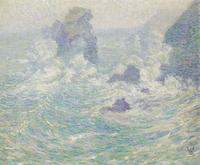
Seascape
Willy Schlobach
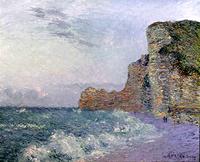
Cliffs in Normandy Evening
Gustave Loiseau
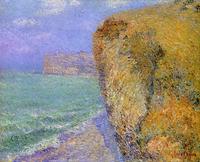
Cliffs at Grainval
Gustave Loiseau
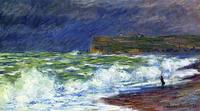
The Beach at Fecamp
Claude Monet
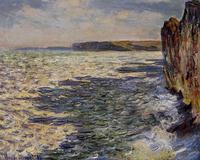
Waves and Rocks at Pourville
Claude Monet
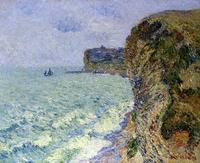
Grainville Cliff near Fecamp
Gustave Loiseau
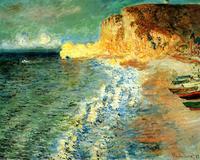
Morning at Etretat
Claude Monet
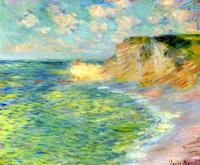
Cliffs at Amont
Claude Monet
Cliff at Pourville
Claude Monet
Cliffs at Pourville in the Fog
Claude Monet
The Sea at Fecamp
Claude Monet
Cliffs at Pourville, Rain
Claude Monet
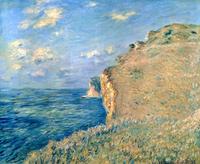
Cliff at Fecamp
Claude Monet
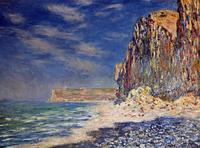
Cliff near Fecamp
Claude Monet
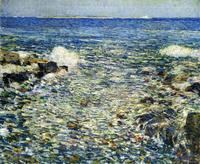
Surf, Isles of Shoals
Childe Hassam
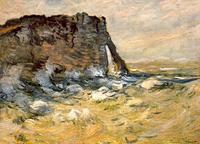
Port d`Aval
Claude Monet
Sea Scene
John Henry Twachtman