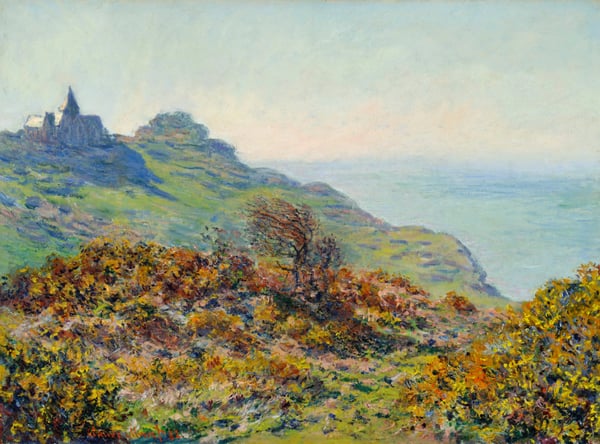
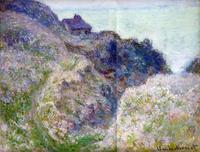
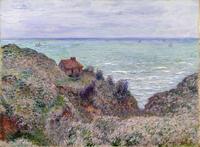
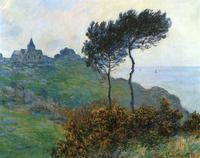
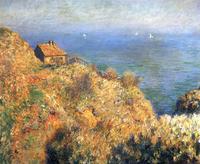
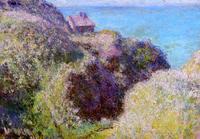
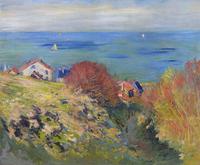
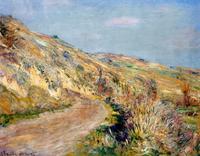
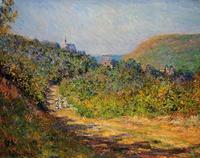
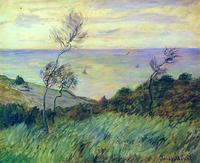
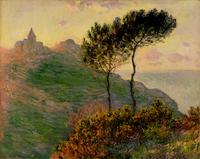
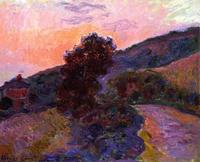
Based solely on the provided facts, “The Church at Varengeville and the Gorge of Les Moutiers” by Claude Monet is a significant work within the Impressionist style. As a landscape, it exemplifies the movement’s hallmark focus on capturing transient light and atmospheric conditions in outdoor settings. Monet’s choice to depict both a man-made structure—the church—and a natural feature—the gorge—demonstrates Impressionism’s interest in the interplay between human presence and the environment. The painting’s significance lies in its representation of a specific location (Varengeville) through the artist’s characteristic broken brushwork and vibrant color palette, which together convey a fleeting moment rather than a static, detailed topographical record. This approach aligns with Impressionism’s revolutionary break from academic conventions, prioritizing perceptual truth over idealized form.