
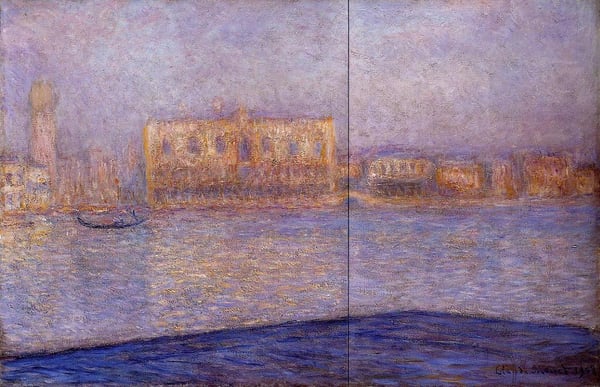
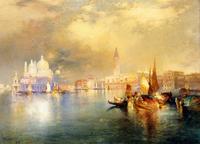
The Doges' Palace Seen from San Giorgio Maggiore 3
Dettagli
Analisi esperta di The Doges' Palace Seen from San Giorgio Maggiore 3 di Claude Monet
Stile: Impressionism · Genere: cityscape
Expert Analysis: "The Doges' Palace Seen from San Giorgio Maggiore 3" by Claude Monet
Claude Monet’s “The Doges' Palace Seen from San Giorgio Maggiore 3” exemplifies the radical innovations of Impressionism, particularly in its treatment of light, color, and atmosphere within the cityscape genre. Painted during Monet’s 1908 visit to Venice, this work is part of a celebrated series in which the artist captured the same iconic view from the island of San Giorgio Maggiore across the basin of St. Mark’s. The painting’s significance lies in its commitment to capturing the fleeting effects of light and weather on the architectural forms, dissolving the solid grandeur of the Doge’s Palace into shimmering planes of color.
Impressionist Technique and Venetian Atmosphere
Monet abandons precise architectural detail in favor of loose, broken brushwork that renders the palace and sky as a mosaic of blues, pinks, golds, and soft grays. The reflections in the lagoon are treated with equal importance, merging the building with its watery mirror. This approach embodies the Impressionist goal of recording the immediate sensory impression — the en plein air moment — rather than constructing a static, topographically accurate view. The painting’s title emphasizes its sequential nature (“3”), reminding us that Monet was obsessed with the changing conditions of light throughout the day, echoing his earlier series on Rouen Cathedral and Haystacks.
Significance within the Style and Period
Within Monet’s oeuvre, the Venetian series marks a late, masterful synthesis of his lifelong exploration of color harmonies and optical effects. “The Doges' Palace Seen from San Giorgio Maggiore 3” is particularly notable for how it balances the ethereal atmosphere of the Venetian lagoon — the golden light and hazy reflections — with the unmistakable silhouettes of the palace and the domes of St. Mark’s. The painting demonstrates that even a historically weighty subject, such as the seat of Venetian power, can be transformed into a study of pure sensory experience, free from narrative or symbolic baggage.
In the context of Impressionism, this work affirms the movement’s enduring legacy: its ability to make the ordinary extraordinary by focusing on how we see rather than what we see. Monet’s Venice proved that the Impressionist method, often associated with rural or suburban scenes, could also revitalize the cityscape genre, influencing subsequent modernists who sought to capture the evanescent beauty of urban light.
Visivamente simili
20 opere con composizione e palette affini
The Doges' Palace Seen from San Giorgio Maggiore 4
Claude Monet
The Doges' Palace Seen from San Giorgio Maggiore 2
Claude Monet
The Doges' Palace Seen from San Giorgio Maggiore, Venice
Claude Monet
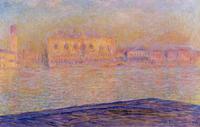
The Doges' Palace Seen from San Giorgio Maggiore
Claude Monet
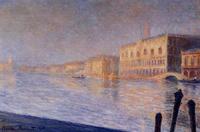
The Doges' Palace
Claude Monet
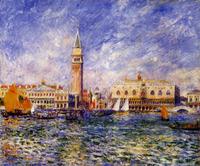
The Doges' Palace
Pierre-Auguste Renoir
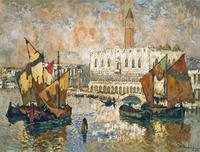
The Doge's Palace, Venice
Konstantin Gorbatov
The Doge's Palace, Venice
Konstantin Gorbatov
The Palazzo Ducale
Claude Monet
The Camponile and Doges Palace, Venice
John Miller
The Palazzo Ducale 2
Claude Monet
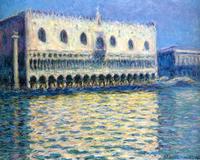
The Palazzo Ducale
Claude Monet
The Carnival Of Venice
Louis Abel-Truchet
San-Marco square in Venice
Eugene Boudin
La Piazzetta, Palazzo Ducale, Venezia
Antonietta Brandeis
The Entrance to the Grand Canal, Venice
Paul Signac
La Piazzetta San Marco Vue De La Lagune
Konstantin Gorbatov
San Giorgio. View of the Mole
Clarence Gagnon
View of Venice
Thomas Moran
Moonlight in Venice
Thomas Moran