Claude Monet sanatçısının Vetheuil, The Church in Winter eseri hakkında uzman analizi
Tarz: Impressionism · Tür: cityscape
Expert Art Historical Analysis: Vetheuil, The Church in Winter by Claude Monet
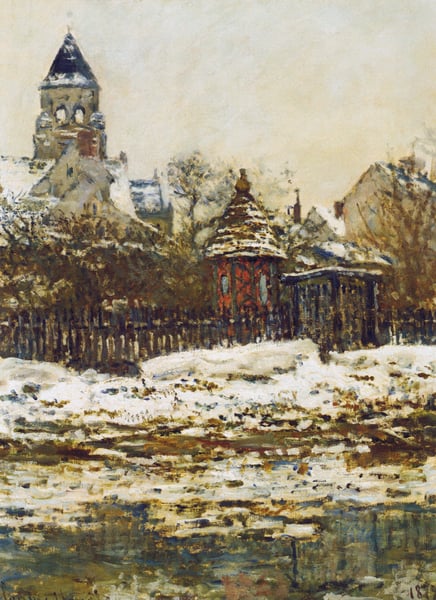
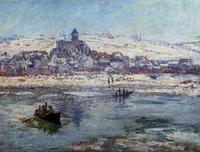
Claude Monet’s Vetheuil, The Church in Winter (c. 1878–79) stands as a quintessential example of Impressionist cityscape painting, demonstrating the movement’s revolutionary approach to capturing atmosphere, light, and the transient effects of weather. Painted during Monet’s stay in the village of Vetheuil, this work transforms a conventional architectural subject—a medieval church—into a study of color and climate rather than a precise topographical record.
Significance within Impressionism
Monet’s choice of a winter setting is central to the painting’s innovation. Rather than depicting the church as a solid, bounded structure, he dissolves its outlines into the cold, muted atmosphere. The canvas is dominated by a palette of soft blues, grays, and whites, with touches of lavender and ochre suggesting refracted light on snow. The church spire rises as a vertical anchor, but its edges blur into the overcast sky, emphasizing the Impressionist goal of portraying the perception of a scene in a specific moment—here, under the diffused, low-angle light of a winter day.
The brushwork is loose and rapid, with visible dabs and strokes that convey the texture of snow-covered rooftops, bare trees, and the frozen ground. Monet avoids strong contrasts and deep shadows, instead using subtle tonal shifts to suggest the quiet, muffled quality of a snowy landscape. This approach aligns with the Impressionist fascination with painting en plein air and capturing ephemeral conditions (fog, rain, snow). The painting is not a documentary of Vetheuil’s church but a record of how the winter atmosphere transforms it: cold, still, and almost spectral.
Contribution to Monet’s Series and Period
Though less famous than Monet’s later series (Rouen Cathedral, Haystacks), Vetheuil, The Church in Winter prefigures that serial approach. During his Vetheuil years (1878–1881), Monet painted the church and its surroundings repeatedly under varying weather and seasons, exploring how the same subject could yield radically different visual experiences. This work, in particular, showcases his skill in rendering the weightlessness of cold air—a challenge distinct from the sparkle of water lilies or the blaze of sunlit fields.
In summary, the painting’s significance lies in its radical subordination of architectural form to atmospheric effect. It exemplifies Impressionism’s core tenet: that the truth of a scene is not its fixed outline but the fleeting interplay of light, color, and weather as perceived by the human eye.
Görsel olarak benzer
İlişkili kompozisyon ve renk paletine sahip 20 eser
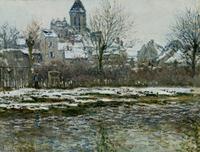
The Church at Vetheuil under Snow
Claude Monet
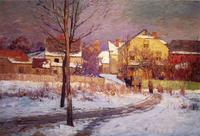
Tinker Place
T. C. Steele
Boulevard Saint-Denis, Argenteuil, in Winter
Claude Monet
Snow Effect, The Street in Argentuil
Claude Monet
Snow at Louveciennes
Alfred Sisley
Snow Scene at Argenteuil
Claude Monet
The Effect of Snow at Hermitage
Camille Pissarro
Snow Effect with Setting Sun
Claude Monet
Snow Effect with Setting Sun
Claude Monet
Vetheuil in Winter
Claude Monet
Arrochar Park, Staten Island
Robert Julian Onderdonk
Frost in Louveciennes
Alfred Sisley
Snow at Argenteuil
Claude Monet
Garden in Louveciennes in the Snow
Alfred Sisley
Landscape at Louveciennes
Camille Pissarro
Snow Rifts Near the Seine
Gustave Loiseau
Winter at Barbizon
Ion Andreescu
Snow Effect at Louveciennes
Alfred Sisley
The Seine at Vetheuil
Claude Monet
Louveciennes Road Snow Effect
Camille Pissarro