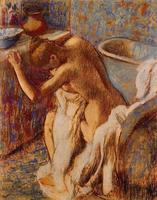
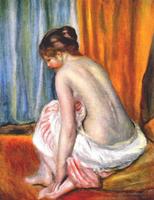
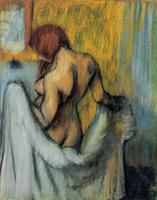
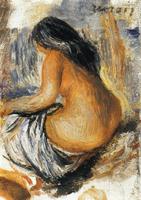
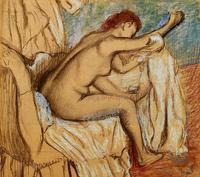
Artwork Analysis: "After Bathing, Woman Drying Herself" by Edgar Degas
Style & Genre: Impressionism / Nude painting (nu)
Significance:
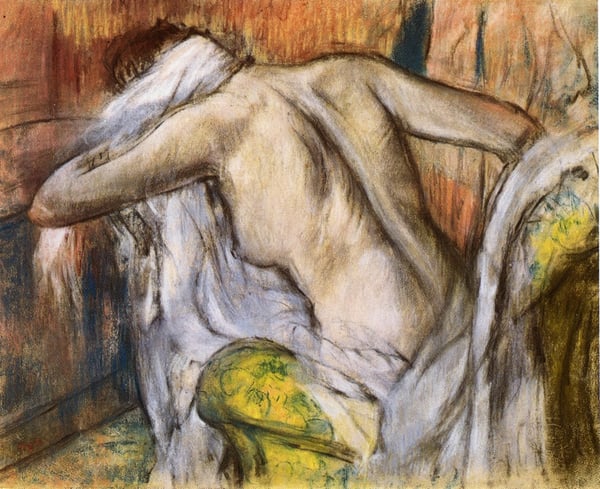
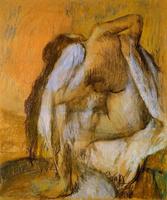
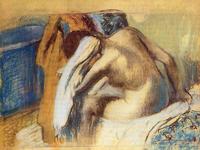
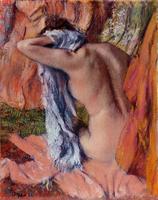
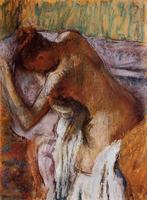
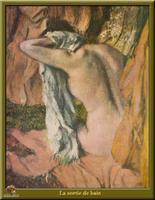
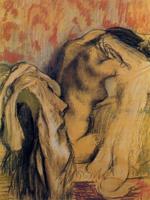
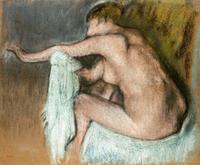
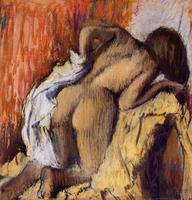
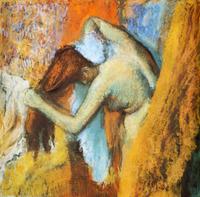
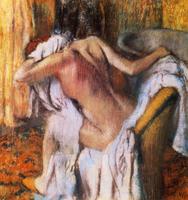
This work exemplifies a radical shift in the depiction of the female nude within Impressionism. Unlike the posed, idealized nudes of academic painting, Degas captures a private, unguarded moment—a woman drying herself after bathing, seemingly unaware of the viewer. The composition is cropped and asymmetrical, influenced by photography and Japanese prints, emphasizing spontaneity over narrative. Degas’s use of pastel (a medium he favored in his later years) allows for a soft, luminous surface that models the body through broken, visible strokes—a hallmark of Impressionist technique. The figure is not a mythological or allegorical subject but a modern, everyday woman, making the work a landmark in the transition toward realism in the nude genre. The pose, with her back turned and towel in hand, subverts the traditional frontal presentation, focusing on gesture and texture rather than idealized beauty. This challenges conventional voyeurism by presenting the woman as active in her own space, not as an object for the male gaze. Thus, the painting is significant for its radical composition, medium, and subject matter, redefining what a “nude” could mean in the Impressionist era.