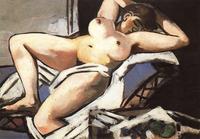
Analysis of "Woman Drying Herself" by Edgar Degas
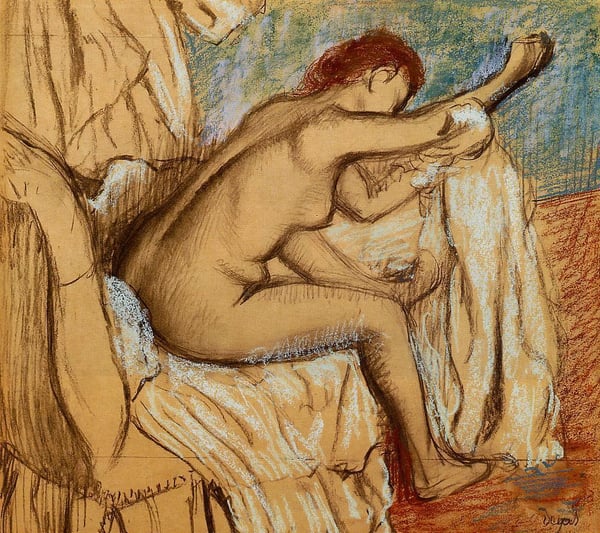
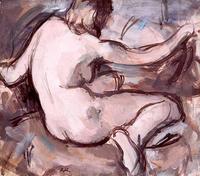
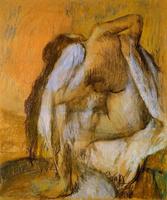
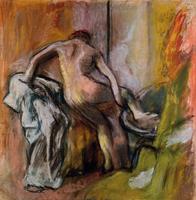
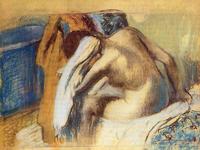
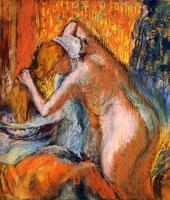
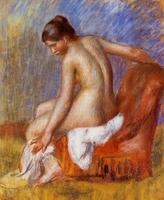
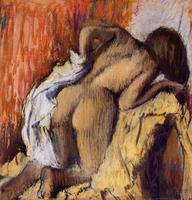
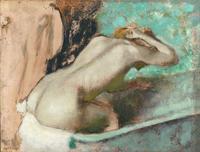
In this intimate pastel, Edgar Degas captures a moment of private, unselfconscious routine—a woman drying herself after a bath. Belonging to the Impressionist movement while also transcending its boundaries, Degas’s approach to the nude painting (nu) genre was revolutionary. Unlike the idealized, mythological nudes of academic tradition, Degas presents a real, contemporary body in a natural, often awkward pose. The figure is viewed from an elevated, almost voyeuristic angle, her back turned, her form defined not by classical perfection but by the honest curves and folds of flesh in motion. The pastel medium allows Degas to blend vibrant strokes of color—oranges, pinks, blues—into a luminous, almost sculptural surface, emphasizing the play of light on skin and towel. The cropping of the body and the inclusion of everyday objects (a basin, a shelf) reinforce the sense of a candid snapshot, a hallmark of Degas’s modernity. This work is significant for challenging the conventions of the nude, shifting the focus from allegory to the authentic, unposed experience of the modern woman in her private world—a radical contribution to Impressionism’s broader project of capturing the fleeting truths of contemporary life.