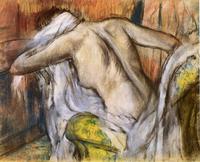
Expert Analysis of "After the Bath (Woman Drying Herself)" by Edgar Degas
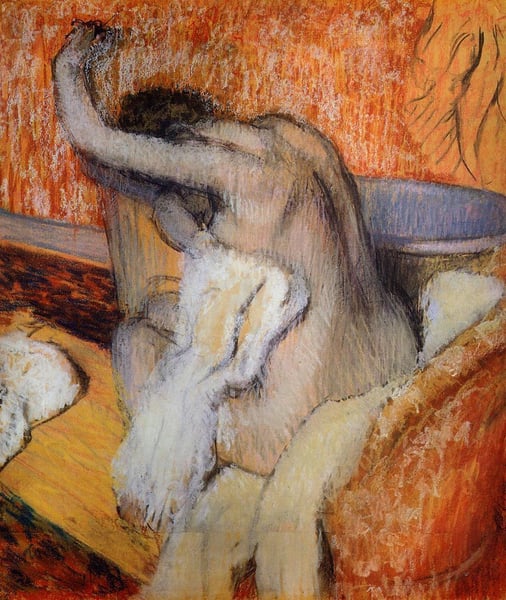
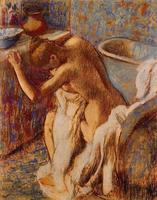
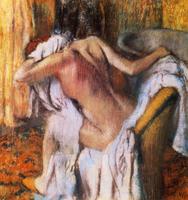
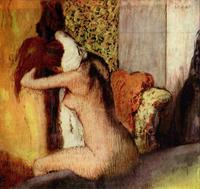
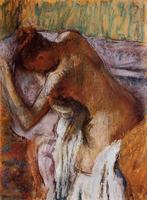
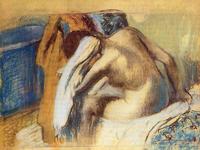
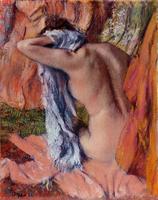
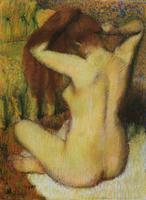
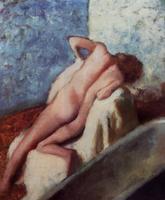
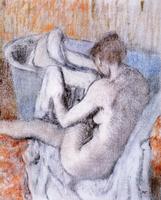
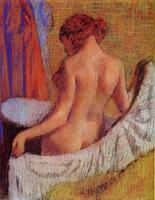
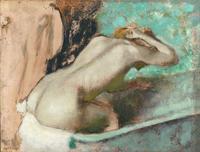
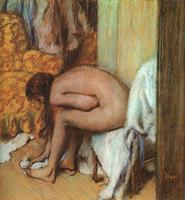
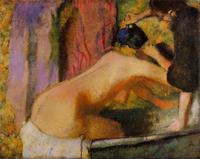
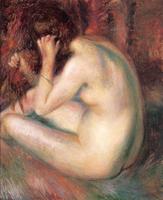
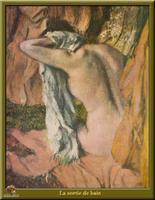
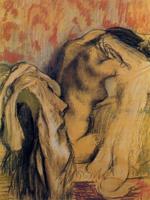
As an Impressionist nude painting, this work is a landmark in the modern redefinition of the genre. Degas departs from the classical, idealized nude—traditionally posed for the viewer’s gaze—and instead captures a woman in a private, unguarded moment of daily routine. The emphasis is not on mythological or allegorical narrative but on the raw, candid gesture of drying herself, rendered with the quick, broken brushwork and unusual viewpoints characteristic of Impressionism.
The significance lies in how Degas uses Impressionist techniques—cropped composition, oblique angles, and a focus on light catching the skin and fabric—to transform the nude from a timeless symbol into a fleeting, observed instant. By choosing a "behind-the-scenes" pose (the woman’s back is turned, face hidden), he rejects the front-facing, inviting pose of traditional nudes, asserting a new, more honest intimacy. This work exemplifies Impressionism’s core ambition: to capture the sensory experience of modern life, including the unglamorous, private acts that earlier art would have deemed unworthy or indecorous. It is a radical, quiet masterpiece of the period.