
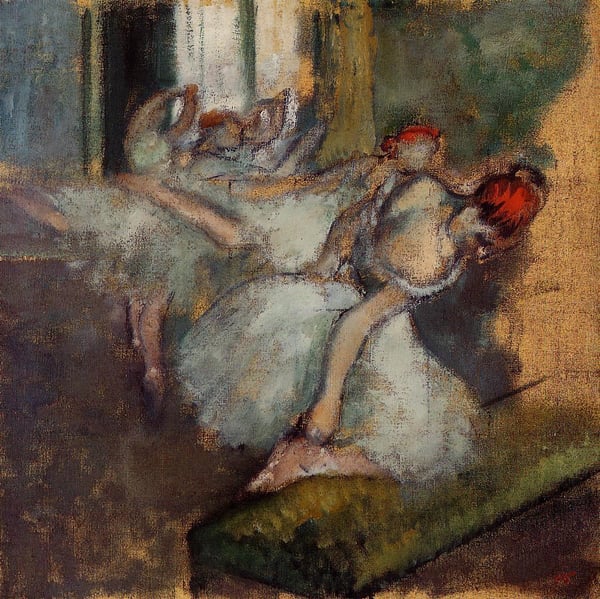
Analisi esperta di Ballet Dancers di Edgar Degas
Stile: Impressionism · Genere: genre painting
Expert Analysis: "Ballet Dancers" (c. 1874–1876) by Edgar Degas
Edgar Degas’s Ballet Dancers stands as a quintessential example of Impressionism’s revolutionary approach to subject matter and technique, while also revealing the artist’s unique obsession with the world of professional dance. Although classified as a genre painting—depicting scenes from everyday life—Degas elevates this routine backstage moment into a profound study of movement, light, and the unglamorous reality behind performance.
Composition and Perspective
Degas deliberately crops the figures, a compositional device borrowed from photography and Japanese prints. The dancers appear caught mid-motion, as if observed through a private, split-second glimpse. The off-center arrangement—with one dancer adjusting her costume and others stretching or waiting—creates a sense of spontaneous, candid observation rather than a staged tableau. This unconventional framing challenges traditional balance and emphasizes the fleeting, momentary nature of Impressionist vision.
Light and Color
The painting’s pastel palette—soft pinks, pale blues, and creamy whites—suffuses the scene with a diffused, artificial light typical of the rehearsal room. Degas uses quick, broken brushstrokes to suggest the shimmer of tutus and the glow of gaslight on bare shoulders. The colors are not naturalistic but perceptual: they capture the sensory impression of the environment, a hallmark of Impressionism.
Significance within Impressionism
While Degas shared the Impressionists’ interest in modern life and light, he differed by focusing on movement and the human form rather than landscape. Ballet Dancers exemplifies his ability to merge the immediacy of Impressionist technique with a classical artist’s discipline of line and anatomy. Moreover, Degas refuses to idealize the dancers; he shows them stretching, scratching, or exhausted—a stark contrast to the ethereal stage persona. This behind-the-scenes realism was groundbreaking, revealing the physical labor and camaraderie of the ballet corps.
Legacy
The work is significant for how it expands genre painting—traditionally a domestic or mundane scene—into a vehicle for experimental form and psychological insight. Degas’s repeated focus on dancers (over 1,500 works) creates a comprehensive study of motion and light, foreshadowing modern photography and film. Ballet Dancers remains a masterwork of Impressionism precisely because it captures not just a moment, but the tension between grace and effort, spectacle and reality.
Museum / Gallery
Visivamente simili
20 opere con composizione e palette affini

Two Dancers on a Bench
Edgar Degas

Group of Dancers
Edgar Degas
Dancers at the Barre
Edgar Degas

Before the Ballet (detail)
Edgar Degas

Dancers
Edgar Degas

Pink Dancer
Edgar Degas

Dancers
Edgar Degas

Ballet Scene
Edgar Degas
Two Dancers in the Foyer
Edgar Degas

Snowflakes
Zinaida Serebriakova

Dancer Adjusting Her Sandel
Edgar Degas

Pink Dancer
Edgar Degas
Two Dancers in the Studio (Dance School)
Edgar Degas

Two Dancers Resting
Edgar Degas
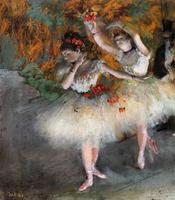
Two Dancers Entering the Stage
Edgar Degas

Two Dancers at Rest (Dancers in Blue)
Edgar Degas
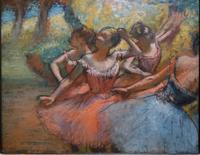
Four Ballerinas on Stage
Edgar Degas

Ballet Scene
Edgar Degas
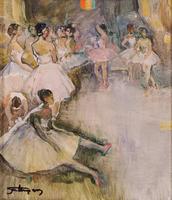
Backstage
Boyukagha Mirzazade

Dancer at the Barre
Edgar Degas