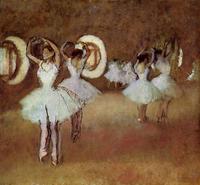
Expert Analysis of "Two Dancers in the Studio (Dance School)" by Edgar Degas
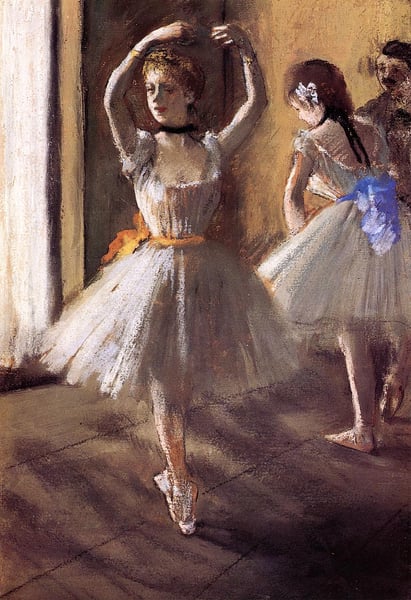
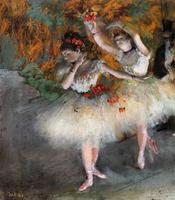
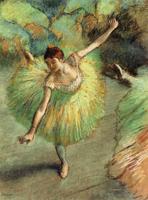
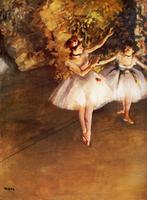
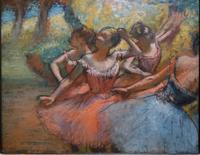
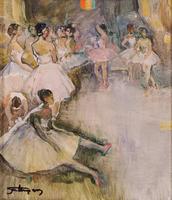
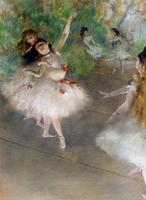
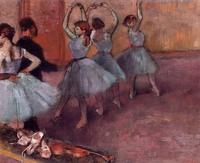
As a hallmark of Impressionist genre painting, Degas’ Two Dancers in the Studio (Dance School) captures a fleeting, private moment of rehearsal rather than a staged performance—a signature of his revolutionary approach. The work exemplifies Impressionism’s interest in modern life and everyday scenes, but Degas distinguishes himself through his rigorous focus on line, form, and the mechanics of the human body. Here, the two dancers are caught mid-motion, one adjusting her dress, the other stretching, emphasizing the raw, unglamorous reality behind ballet’s grace. The composition is deliberately asymmetrical, with empty floor space echoing the studio’s atmosphere, drawing the viewer into an intimate, almost voyeuristic perspective. Degas’ use of muted tones and pastel-like softness (typical of his later works) suggests the fleeting effects of light filtering through the studio. The painting is significant as it challenges traditional history painting by elevating a mundane backstage vignette to high art, and it showcases Degas’ unique synthesis of Impressionist color and classical draftsmanship. This work, like his broader dancer series, redefined genre painting by focusing on the physicality and discipline of the dancers, making the ordinary extraordinary.