
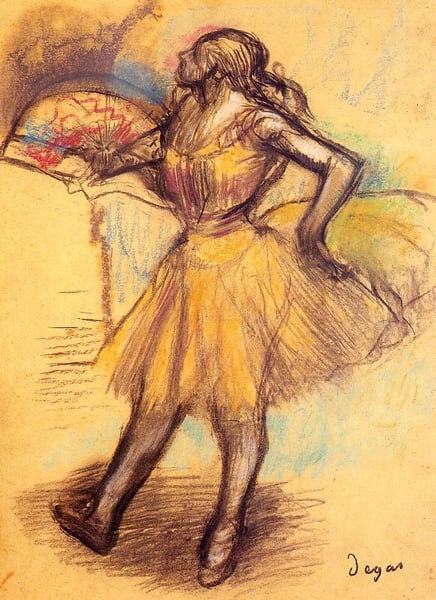
Edgar Degas の Dancer with a Fan (study) の専門的な分析
スタイル:Impressionism · ジャンル:sketch and study
Expert Analysis: "Dancer with a Fan (study)" by Edgar Degas
This work is a quintessential example of Edgar Degas’s experimental approach to Impressionism, specifically within his obsessive exploration of the ballet world. As a sketch and study, its significance lies not in polished finish but in its raw, intimate documentation of process—a hallmark of the Impressionist commitment to capturing fleeting moments and the artist’s immediate perception.
Stylistic and Period Significance
- Impressionism in Practice: While Degas is often grouped with the Impressionists, he distinguished himself by prioritizing line, structure, and the human figure over pure landscape and color. In this study, visible, rapid strokes and exposed canvas or paper evoke the sense of a transient instant—the dancer pausing with a fan, caught mid-gesture. The study form itself embodies the Impressionist rejection of academic finish in favor of spontaneity.
- Obsession with Movement and Unconventional Angles: Degas famously used dancers as his primary subject, but his innovation lies in cropping, asymmetry, and unusual viewpoints. Here, the fan becomes a dynamic prop that cuts across the figure, introducing a geometric counterpoint to the soft curves of the dancer’s pose. The sketch’s rough edges and incomplete background direct all attention to the tension between the dancer’s body and the unfolding fan, suggesting motion even in a static study.
Genre and Medium as Meaning
- The Study as Finished Art: Unlike a preparatory sketch meant to be hidden, Degas exhibited studies like this as autonomous works. The visible pentimenti (reworked lines) and pastel-like smudging (if present) become features, not flaws. They reveal the artist’s thought process—the search for the perfect arabesque of the arm or the angle of the fan tip. This transparency was radical: it elevated the act of seeing and recording over the illusion of perfection.
- The Fan as Cultural Code: In 19th-century Paris, fans were accessories of feminine allure and social ritual. By pairing a dancer with a fan, Degas conflates backstage professionalism with bourgeoise fashion, subtly commenting on the commodification of the performer’s body. The study format highlights this duality—the dancer is both a worker and an object of aesthetic contemplation.
What Makes It Significant
- It encapsulates Degas’s synthesis of "artifice and reality" (his own words). The sketch is unfinished yet utterly resolved, proving that an Impressionist study can convey as much depth—narrative, formal, and psychological—as a large-scale canvas.
- It demonstrates Degas’s radical method of learning and unlearning: he would trace, retrace, and layer studies to capture the illusion of spontaneity. This piece likely preceded a more finished work, but stands alone as a testament to the power of the provisional mark—the very essence of modernism’s break from the academic tradition.
In short, Dancer with a Fan (study) is not a mere preparatory note; it is a purposeful, finished statement of Impressionist values: motion, ephemera, and the beauty of the incomplete.
Museum / Gallery
視覚的に類似
構図やパレットが近い作品 20 件

Dancer with a Fan
Edgar Degas
Dancer with a Fan
Edgar Degas
Dancer
Edgar Degas
Three Dancers in Yellow Skirts
Edgar Degas
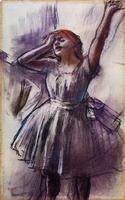
Dancer with Left Arm Raised
Edgar Degas

Dancer arranging her hair
Edgar Degas
Dancers
Edgar Degas

Three Dancers
Edgar Degas
Two Dancers
Edgar Degas

Dancer
Émilie Charmy

Dancer Seated (study)
Edgar Degas

Dancer with a Fan
Edgar Degas

Dancer
Edgar Degas
Three Dancers
Suzanne Valadon

Red Ballet Skirts
Edgar Degas

Three Ballet Dancers, One with Dark Crimson Waist
Edgar Degas
Two Dancers
Edgar Degas

Two Dancers
Edgar Degas
Dancer Standing (study)
Edgar Degas
Three Dancers, Green Blouses
Edgar Degas