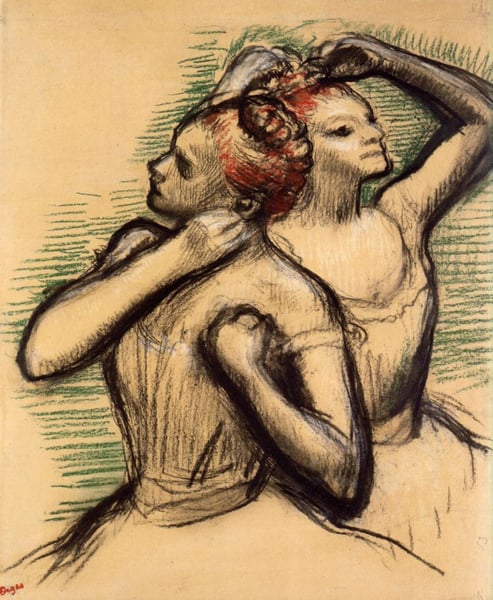
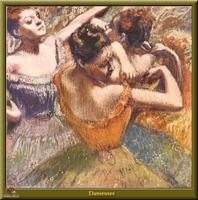
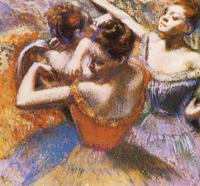
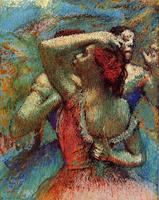
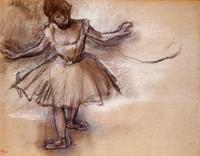
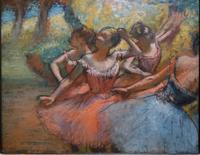
The significance of Edgar Degas's Two Dancers lies in its dual identity as both an Impressionist work and a revealing sketch-and-study. Within the Impressionist movement, Degas distinguished himself by prioritizing line, movement, and the unposed moment over the atmospheric play of light pursued by his contemporaries. As a sketch and study, this piece offers a rare window into Degas’s working method—a deliberate, almost analytical dissection of the human form in motion. The figures are not polished, finished portraits but rather a record of observation: the artist capturing the tension in a dancer’s leg, the turn of a neck, or the alignment of bodies in rehearsal. This directness—the visible, searching strokes and the economy of detail—embodies the Impressionist ethos of immediacy, yet it also reveals Degas’s classical training and his obsession with documenting the fleeting reality of backstage life. In Two Dancers, the significance is found in the balance between spontaneity and structure: a raw, unglamorous study that nonetheless elevates the everyday moment into a masterclass of movement and gesture.