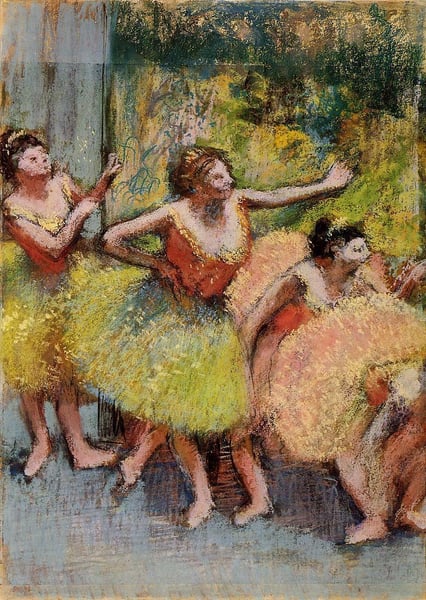
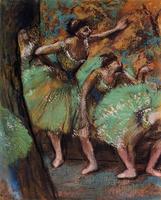
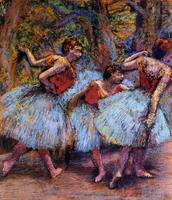
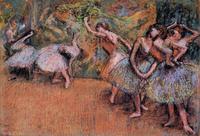
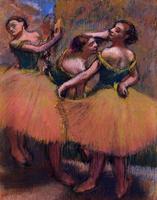
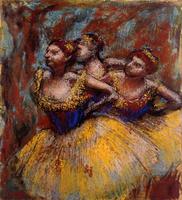
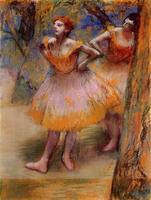
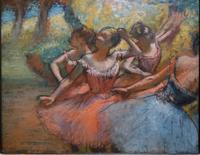
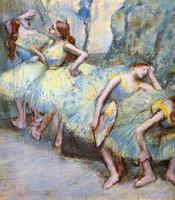
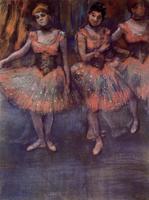
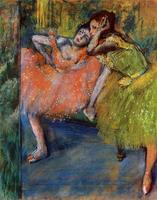
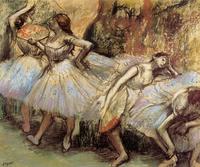
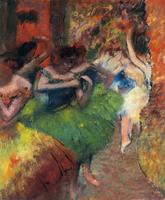
"Dancers in Green and Yellow" exemplifies Edgar Degas’s revolutionary approach to Impressionism, particularly through his obsessive focus on the ballet—a quintessentially modern, urban subject. While many Impressionists painted landscapes en plein air, Degas preferred the controlled, artificial light of the stage and rehearsal room, capturing dancers in candid, unposed moments. In this work, the vibrant green and yellow tutus against muted backdrops showcase his mastery of pastel, a medium he favored for its immediacy and ability to blend color with linear precision. The composition draws on photography and Japanese prints: an off-center viewpoint, cropped figures, and asymmetrical balance that suggests a slice of life caught in motion. This painting is significant not only for its radiant palette and dynamic energy but also for how it merges genre painting with Impressionist technique—recording the fleeting, unglamorous reality of backstage labor while celebrating the beauty of artifice. Degas thereby redefines the genre, elevating a common rehearsal scene into a study of color, light, and modern urban experience.