
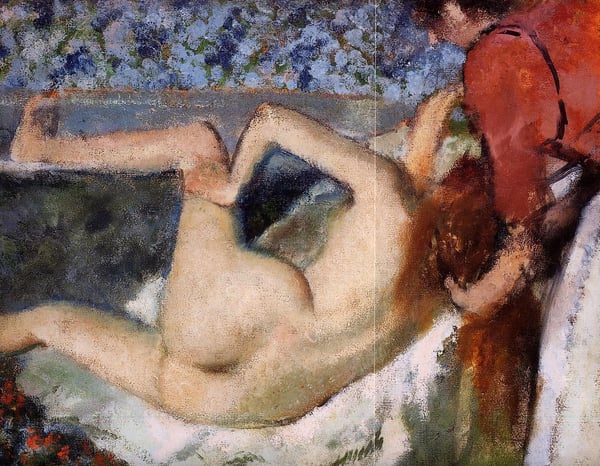
Analisi esperta di The Bath (Woman from Behind) di Edgar Degas
Stile: Impressionism · Genere: nude painting (nu)
Expert Analysis: "The Bath (Woman from Behind)" by Edgar Degas
Edgar Degas’s The Bath (Woman from Behind) is a striking example of Impressionist innovation within the traditional genre of the nude (nu). Painted in the 1880s, the work exemplifies Degas’s radical departure from classical, idealized depictions of the female form. Instead of a goddess or odalisque posed for the viewer’s gaze, Degas presents an intimate, unguarded moment: a woman seen from the back, bending over a shallow basin, absorbed in washing herself.
Significance within Impressionism and the Nude Genre
-
Rejection of Academic Convention – Unlike the poised, front-facing nudes of the Salon tradition (e.g., Ingres’s La Grande Odalisque), Degas’s figure is anonymous and unidealized. The back view eliminates facial expression and direct engagement, shifting focus from narrative to the raw physicality of the body in motion. The pose is awkwardly real—a snapshot of private ritual rather than staged beauty.
-
Unconventional Composition – The cropping is audacious. The woman’s head is cut off at the top, and the tub cuts through the lower right corner, borrowing from photography and Japanese ukiyo‑e prints. This asymmetric framing places the viewer in a voyeuristic position, as if glimpsing the scene through a keyhole—a hallmark of Degas’s modernity.
-
Mastery of Pastel and Light – Degas executed this work primarily in pastel, a medium he pioneered in Impressionist circles. The dry, chalky texture allows for luminous, broken strokes of color—blue, lavender, and ochre—that model the back and spine without hard outlines. Light falls across the woman’s shoulders and hip, while the surrounding space (the blue basin, the patterned wall) dissolves into atmospheric haze, emphasizing the fleeting, sensory impression of the moment.
-
The “Bath” Series as a Modernist Breakthrough – Woman from Behind belongs to Degas’s famous series of bathers, which redefined the nude for the late 19th century. By focusing on a back view and a mundane action (bathing), Degas stripped away erotic spectacle, presenting instead a neutral observation of daily life. This psychological distance prefigures later Modernist concerns with fragmentation and alienation.
Conclusion
The Bath (Woman from Behind) is significant because it encapsulates Impressionism’s break from tradition through its casual pose, radical cropping, and emphasis on private, unposed reality. Degas treats the nude not as an object of beauty but as a subject of everyday existence—a bold reimagining that paved the way for 20th‑century art’s exploration of the body as process rather than icon.
Visivamente simili
20 opere con composizione e palette affini
Woman at Her Bath
Edgar Degas
Sleeping Nude with Hat (Repose)
Pierre-Auguste Renoir
After the Bath
Edgar Degas
After Bath
Adam Baltatu
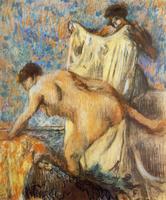
Woman Leaving Her Bath
Edgar Degas
Naked women in a landscape
Arturo Souto
After Bathing, Seated Female Nude
Pierre-Auguste Renoir
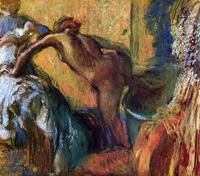
After the Bath
Edgar Degas
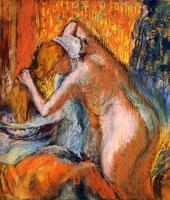
After the Bath, Woman Drying Her Hair
Edgar Degas
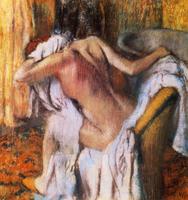
After the Bath, Woman Drying Herself
Edgar Degas
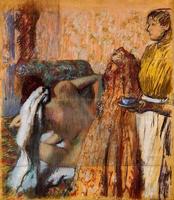
Breakfast after Bath
Edgar Degas
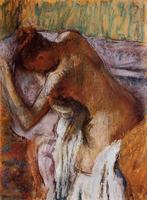
After the Bath
Edgar Degas
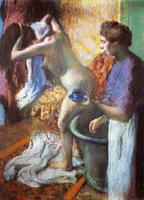
The Cup of Tea (Breakfast after Bathing)
Edgar Degas
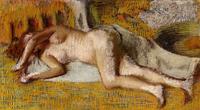
After the Bath
Edgar Degas
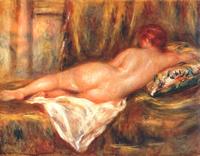
Reclining nude
Pierre-Auguste Renoir
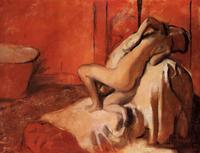
After the Bath
Edgar Degas
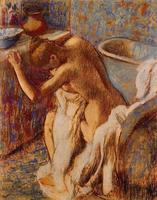
Woman Drying Herself
Edgar Degas
The big blue naked
Pierre Bonnard
Afternoon in Naples
Paul Cezanne
Nude in an Armchair
Pierre-Auguste Renoir