
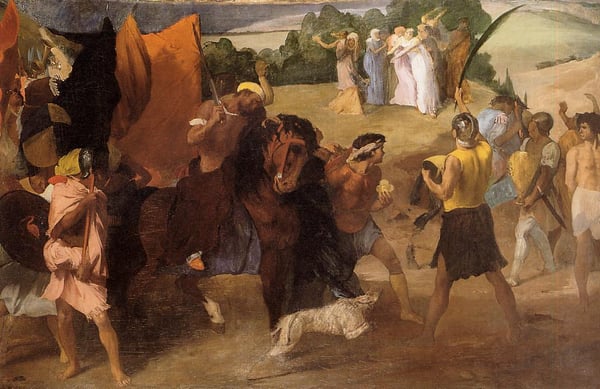
Expertenanalyse zu Edgar Degass The Daughter of Jephtha
Stil: Impressionism · Genre: religious painting
As an expert art historian, I will analyze "The Daughter of Jephtha" by Edgar Degas strictly based on the supplied structured facts: the artwork is an Impressionist religious painting. This combination alone makes the work highly significant within both the Impressionist movement and Degas’s own career.
Significance within Impressionism and Religious Genre
-
Rarity of the Subject in Impressionism: Impressionism is overwhelmingly associated with modern life—Parisian streets, leisure scenes, landscapes, and portraits. Religious narratives were rare, as the movement’s core philosophy prioritized capturing fleeting moments of contemporary existence over historical or biblical themes. Degas’s decision to paint a religious subject marks a bold departure from the typical Impressionist canon. “The Daughter of Jephtha” stands as an outlier, demonstrating that the Impressionist sensibility could be applied to sacred history, challenging the notion that the style was incompatible with traditional high art.
-
Fusion of Technique and Tradition: By classifying this work as Impressionist, we recognize that Degas employed the movement’s hallmarks—visible brushwork, attention to light and atmosphere, and a sense of momentary capture—within a biblical scene. This fusion creates a unique tension: the timeless, dramatic Old Testament story of Jephtha’s vow and his daughter’s sacrifice is rendered with an immediacy that usually belongs to secular, everyday observation. The significance lies in how Degas modernizes a classical religious narrative, making it feel both intimate and psychologically charged, rather than didactic or monumental. This anticipates later Impressionist experiments with historical and mythological themes.
-
Degas’s Early Monumental Ambitions: While Degas is celebrated for his ballet dancers and horse races, “The Daughter of Jephtha” (painted around 1859–1860) belongs to his formative years. Its religious genre reveals his academic training and ambition to rival history painting, yet the Impressionist label signals his early break from rigid academicism. The work thus occupies a pivotal moment: it is both a tribute to tradition and a prelude to the revolutionary style that would define his mature period. Its significance is as a transitional piece, showing an Impressionist artist grappling with the highest genre of painting (history/religion) before fully turning to modern subjects.
In summary, “The Daughter of Jephtha” is significant because it proves that Impressionism could engage with religious iconography, blending the movement’s innovative painterly approach with the gravitas of biblical narrative. It enriches our understanding of Degas’s range and the broader boundaries of Impressionist art.
Museum / Gallery
Visuell ähnlich
20 Werke mit ähnlicher Komposition und Farbpalette
Alexander and Bucephalus
Edgar Degas
Alexander and Porus
Charles Le Brun
The Battle of the Amazons
Peter Paul Rubens
Valentinus Taken Prisoner
Otto van Veen
Crusaders Thirsting near Jerusalem
Francesco Hayez
The Batavian Siege of the Roman Army Camp
Otto van Veen
The battle of the Taro
Tintoretto
The Stoning of St. Stephen
Adam Elsheimer
The Road to Calvary
Charles Le Brun
Victory of Joshua over the Amalekites
Nicolas Poussin
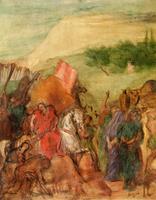
The Daughter of Jephtha (study)
Edgar Degas

The Romans Under Claudius Civilis Cerealis Defeated by the Treachery of a Batavian
Otto van Veen
A Roman Triumphal Entry, Possibly of Marcus Claudius Marcellus
Vincenzo Camuccini
The Triumph of Love
David Scott
Rudolf von Habsburg on the body of Přemysl Ottokar, King of Bohemia
Anton Romako
Funeral of ruthenian noble by Siemiradzki
Henryk Siemiradzki
Brinio Raised Upon the Shield
Otto van Veen
The Sabine Women
Jacques-Louis David
Warriors in the Battle of Silistria
Henryk Siemiradzki
Elisha Refusing Gifts from Naaman
Ferdinand Bol