Expert analysis of Edgar Degas’s The Daughter of Jephtha (study)
Style: Impressionism · Genre: sketch and study
Expert Analysis: "The Daughter of Jephtha (study)" by Edgar Degas
Context and Significance
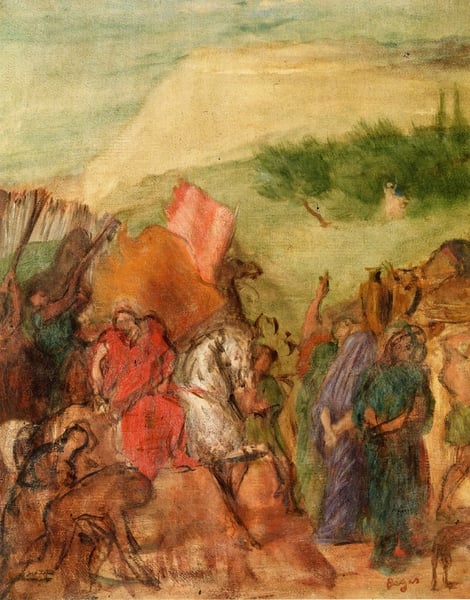
This work, a preliminary sketch for a larger composition, exemplifies Edgar Degas’s continuous dialogue between academic tradition and the emerging Impressionist movement. Though Degas is synonymous with Impressionism—particularly his scenes of ballet dancers, horse races, and modern Parisian life—his early training at the École des Beaux-Arts and his admiration for Ingres and Delacroix ingrained in him a rigorous draftsmanship. The Daughter of Jephtha (study) is a revealing artifact of that tension, showcasing Degas’s evolving approach to narrative, composition, and the fleeting moment.
Stylistic and Technical Attributes
As a study, the work is not a finished exhibition piece but a working document—a window into Degas’s process. The handling is loose yet deliberate: swift, broken lines outline the figure, while patches of muted wash or hatch marks suggest volume and movement. This aligns with the Impressionist emphasis on spontaneity and capturing a “sensation,” but Degas never abandoned structure. The subject itself—a biblical story from the Book of Judges (Jephtha’s tragic vow)—is a classical, even Romantic, theme, yet Degas treats it with a modern eye. The daughter’s pose is poised between despair and dignity, her form traced with an energy that anticipates the dancer studies for which Degas would later become famous.
Significance within Impressionism and Degas’s Oeuvre
- Bridging tradition and innovation: Degas’s choice to execute a study for a historical painting reflects his roots in the academic history-painting tradition. However, the sketchy, unfinished quality—valued by Degas as a legitimate artistic state—rejects the polished finish demanded by the Salon. This aligns with the Impressionist belief in the autonomy of the artist’s vision over official conventions.
- Preparation as art: The work demonstrates that for Degas, the preparatory stage was not merely a step toward a final painting but a destination in itself. His studies often possess a life and intimacy that full-scale compositions lack. Later, Degas would famously say that painting is “the art of the sketch.”
- Narrative vs. instantaneous observation: While Degas’s Impressionist peers (Monet, Renoir) favored direct observation of contemporary life, Degas often reworked historical or literary subjects. The Daughter of Jephtha (study) shows him filtering antiquity through a modern, psychologically attuned gaze—a hallmark of his mature style.
Why It Matters
This study is significant because it reveals Degas’s foundational belief that “drawing is not what you see but what you must make others see.” It is a record of intellectual and technical enquiry, fusing the precision of classicism with the fluidity of Impressionism. For art historians, it provides crucial insight into how Degas deconstructed a dramatic biblical scene into essential lines and tones—a method he would later apply to the fleeting gestures of dancers and jockeys. In its raw, unfinished state, the work embodies the very spirit of Impressionism: the primacy of the artist’s immediate perception and the beauty of the incomplete.
Museum / Gallery
Genre
Style
Visually similar
20 works with related composition and palette
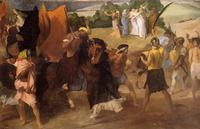
The Daughter of Jephtha
Edgar Degas
Alexander and Bucephalus (detail)
Edgar Degas
Massacre of Chios (Study)
Eugene Delacroix
The battle of the Taro
Tintoretto
Siege of Pskov by Polish King Stefan Batory in 1581
Karl Bryullov
The seventh crusade against Jerusalem
Francesco Hayez
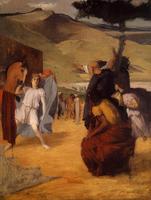
Alexander and Bucephalus
Edgar Degas
The Refugees
Honore Daumier
The Daughter of Zion
Jean-François Portaels
Death Offers Crowns to the Winner of the Tournament
Gustave Moreau
The Concert of the State
Rembrandt
Emigrants or Fugitives
Honore Daumier
Martyrdom of St. Andrew (introduction to the Crucifixion)
Guido Reni
Irminsul
Hermann Wislicenus
The Abduction of Bulls
Peter Paul Rubens
Pentesilea
Arturo Michelena
After the Battle of Kulikovo
Valentin Serov
Lion Hunt
Eugene Delacroix
Truce between Romans and Sabines
Peter Paul Rubens
Orpheus in the Underworld
Henryk Siemiradzki