Expertenanalyse zu Edgar Degass View of Saint-Valery-sur-Somme
Stil: Impressionism · Genre: cityscape
Expert Analysis: "View of Saint-Valery-sur-Somme" by Edgar Degas
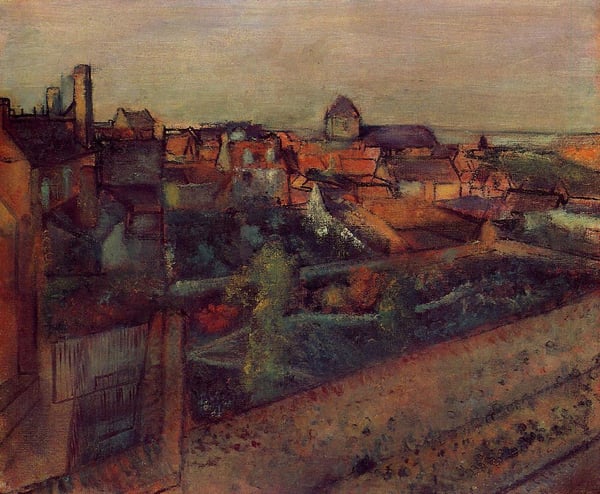
Edgar Degas is best known for his intimate scenes of ballet dancers, café life, and laundresses, but View of Saint-Valery-sur-Somme reveals a less familiar side of the artist: his engagement with pure Impressionist landscape and the cityscape genre. Painted during a stay in the coastal town of Saint-Valery-sur-Somme, this work is significant for how it demonstrates Degas’s adaptation of Impressionist principles—particularly the study of light and atmosphere—to a subject that typically falls outside his favored indoor, figure-centric compositions.
Composition and Color
Degas constructs the scene with a characteristic off-center, diagonal sweep: the curve of the harbor or riverbank draws the eye from the lower left into the distance, while the sky occupies the upper two-thirds of the canvas. This asymmetry, a hallmark of Degas’s Japanese-inspired cropping and photographic framing, gives the viewer a sense of glimpsing a quiet, transient moment. The palette is restrained yet luminous, with soft blues, pale greens, and warm grey-violets reflecting the damp, coastal light of northern France. Brushwork is loose but controlled—typical of Degas’s mature Impressionist handling—allowing the architecture and water to dissolve into vibrating patches of color.
Significance within Impressionism and Degas’s Oeuvre
-
A Departure from the Figure: Unlike many of Degas’s interiors, this cityscape is devoid of overt human activity. The absence of dancers or other figures shifts focus entirely to the ambiance—the particular quality of light on the town’s roofs, the reflection in the still water, the hazy distance. In doing so, Degas aligns himself with the Impressionist goal of capturing a fleeting atmospheric effect, akin to the landscapes of Monet or Sisley. Yet the composition remains meticulously structured, revealing Degas’s classical training.
-
Plein-Air Experimentation: While Degas often resisted painting outdoors (preferring to work from memory or sketches), View of Saint-Valery-sur-Somme likely involved some direct observation. The naturalness of the light and the subtle tonal gradations suggest a painter responding quickly to the moment—a key Impressionist practice. This work thus stands as evidence that Degas could, when he chose, master the plein-air approach he famously criticized in others.
-
Urban/Nature Interaction: The painting captures a quiet border zone between town and nature—the architecture of Saint-Valery-sur-Somme nestles into the estuary landscape. This tension between the man-made (roofs, quays, boats) and the natural (water, sky, distant hills) is a recurrent theme in Impressionist cityscapes. Degas treats both with equal, descriptive sensitivity, uniting them through his consistent handling of reflected light.
-
Technical Refinement: Degas’s use of thin, layered paint and the suppression of black in favor of broken, complementary tones shows his mastery of Impressionist color theory. The sky, in particular, is built from delicate touches of blue and pink that suggest the haze of a seaside afternoon. This technical finesse underscores why Degas is considered both a central Impressionist and a unique voice within the movement.
Conclusion
View of Saint-Valery-sur-Somme is significant because it expands our understanding of Degas beyond the ballet studio. It confirms his ability to apply Impressionist ideals of light, spontaneity, and color to a seemingly simple cityscape, while retaining his own idiosyncratic sense of composition and restraint. The painting stands as a quiet but assured example of how Degas, an artist often at odds with Impressionist dogma, could nevertheless produce work that fully embodies the movement’s pursuit of modern, fleeting beauty.
Visuell ähnlich
20 Werke mit ähnlicher Komposition und Farbpalette
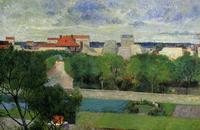
The market gardens of Vaugirard
Paul Gauguin
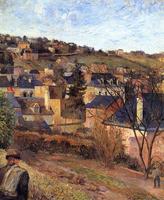
Blue roofs of Rouen
Paul Gauguin
View of Osny near Pontoise
Camille Pissarro
Еhe Red House
Theodore Robinson
The Red House
Theodore Robinson
View of Auvers
Paul Cezanne
Paysage
Bela Czobel
The Center of La Bastide du Vert
Henri Martin
Bela Czobel Napsütötte Háza
Bela Czobel
Rouen suburb
Paul Gauguin
The village of Maurecourt
Berthe Morisot
Giverny
Theodore Robinson
View Of Méréville
Maximilien Luce
Béla Czóbel
Bela Czobel
Landscape at Essoyes
Pierre-Auguste Renoir
Houses at Vaugirard
Paul Gauguin
Ile de Bréhat
Samuel Peploe
La Butte Pinson
Maurice Utrillo
Street in Essoyes
Pierre-Auguste Renoir
Houses at Saint Cirq Lapopie
Henri Martin