
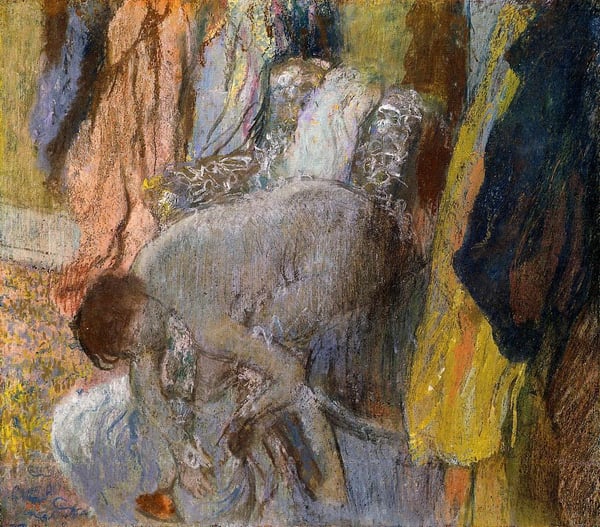
Analisi esperta di Woman Washing Her Feet di Edgar Degas
Stile: Impressionism · Genere: nude painting (nu)
Expert Analysis: "Woman Washing Her Feet" by Edgar Degas
Edgar Degas’s Woman Washing Her Feet (circa 1886–1890) stands as a quintessential example of Impressionism’s radical rethinking of the nude—a genre traditionally reserved for idealized, mythological, or historical figures. Here, Degas strips the female form of any heroic or erotic pretense, presenting a woman in a profoundly private, unposed moment of daily hygiene.
Break with Academic Tradition
Unlike the polished, reclining Venuses of Ingres or Titian, Degas’s bather is caught mid-action, her body contorted into a natural but awkward pose: one leg raised, torso bent forward, hands reaching to wash a foot. The composition is deliberately off-center and seemingly haphazard, as if glimpsed through a keyhole or a camera lens—a technique reflecting Degas’s fascination with photography and Japanese ukiyo-e prints. The viewer becomes an unseen observer, intruding on an intimate ritual.
Impressionist Technique and Materiality
Executed primarily in pastel, the work exemplifies Degas’s late-career shift toward this medium, which allowed for vibrant, layered strokes that seem to shimmer with light. The woman’s flesh tones are built from broken touches of pink, peach, and cool blue—accents that suggest the play of studio light across her back and arms. The background is loosely rendered in broad, hatched marks of white, gray, and ochre, dissolving into abstract color patches that emphasize the figure’s physical presence over any defined setting. This focus on optical sensation over linear clarity is a hallmark of Impressionist painting.
Significance within Degas’s Oeuvre
Woman Washing Her Feet belongs to Degas’s celebrated series of nudes in bath or boudoir settings—works that scandalized 19th-century audiences for their unglamorous truthfulness. Rather than a goddess, Degas shows a real woman, her face hidden, her posture unflattering yet deeply human. By rejecting the polished finish of academic nudes, he asserts that modern life—even its most mundane acts—deserves artistic dignity. The painting’s cropped, asymmetrical framing and its candid flattening of space anticipate both modernist abstraction and the psychological rawness of later Expressionist figuration.
In essence, Degas transforms the nude from a vehicle for ideal beauty into a study of genuine, unguarded humanity—making Woman Washing Her Feet a pivotal work that redefined what an Impressionist (or any modern) nude could be.
Museum / Gallery
Visivamente simili
20 opere con composizione e palette affini
After the Bath (Woman wiping her left foot)
Edgar Degas
After the Bath, Woman Drying Herself
Edgar Degas
Breakfast after Bathing
Edgar Degas
The big blue naked
Pierre Bonnard
Breakfast after Bath
Edgar Degas
After the Bath
Edgar Degas
After the Bath
Edgar Degas
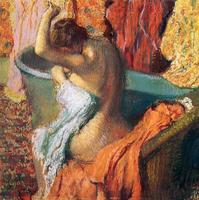
Seated Bather
Edgar Degas
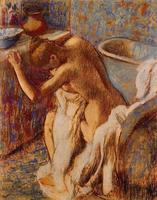
Woman Drying Herself
Edgar Degas
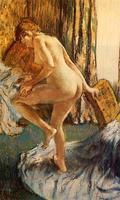
After the Bath
Edgar Degas
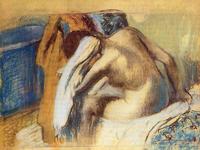
Woman Drying Her Hair
Edgar Degas
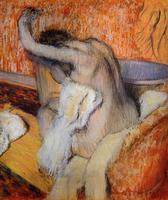
After the Bath (Woman Drying Herself)
Edgar Degas

Study for Susanna and the Elders
Umberto Veruda
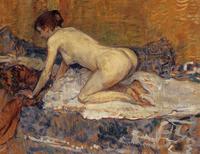
Crouching Woman with Red Hair
Henri de Toulouse-Lautrec
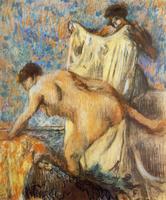
Woman Leaving Her Bath
Edgar Degas
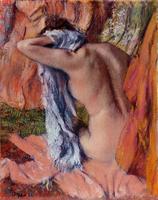
After the Bath
Edgar Degas
The Dressing Room
Émilie Charmy
Rest
Edgar Degas
Sleeping Nude with Hat (Repose)
Pierre-Auguste Renoir
After Bathing, Woman Drying Her Leg
Edgar Degas