Expertenanalyse zu Henri Matisses Studio under the Eaves
Stil: Realism · Genre: interior
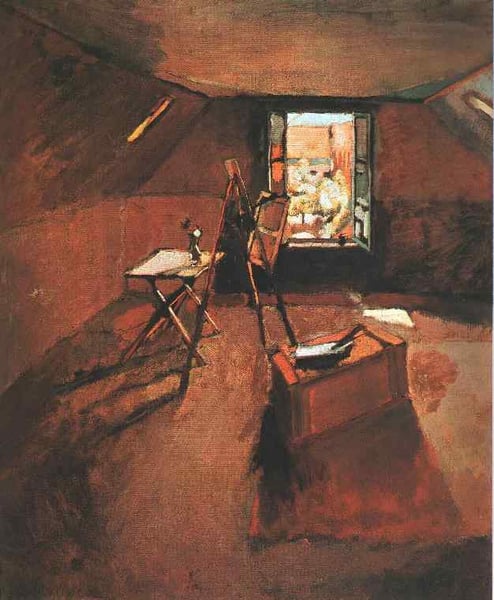
Expert Analysis: "Studio under the Eaves" by Henri Matisse
At first glance, "Studio under the Eaves" appears to be an anomaly within Henri Matisse's celebrated oeuvre, as the artist is best known as a leading figure of Fauvism and later modernism. Yet this work, executed in a Realist style, offers a crucial window into Matisse’s formative years and his deliberate engagement with academic tradition before his radical departure into color and expression.
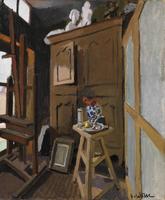
The painting’s genre—an interior—places it firmly within a lineage of 19th-century Realist domestic scenes, echoing the intimate, quiet observations of artists like Gustave Courbet or the early works of Édouard Vuillard. Matisse’s treatment of space is noteworthy: the “under the eaves” perspective compresses the room, forcing the viewer’s eye into a low-ceilinged, almost claustrophobic chamber. This spatial restriction becomes a device for exploring light and shadow, a hallmark of Realism. Notice how the natural light from the window (presumably the sole source) carves out volumes—the stool, the stacked canvases, the easel—with careful, unromantic precision. There is no decorative excess; every object serves the narrative of the artist’s humble workspace.
What makes "Studio under the Eaves" significant within the Realist tradition is its autobiographical candor. Matisse painted this shortly after moving into a cramped Parisian attic studio, a period of financial hardship documented in unsparing detail. Unlike the romanticized garrets of bohemian myth, this interior is stark, almost mundane. The palette is restrained—muted browns, grays, and ochres—eschewing the vibrant hues that would later define his Fauve period. This discipline demonstrates Matisse’s mastery of value and tone, proving that his later boldness was built on a solid foundation of observational realism.
Crucially, the painting also foreshadows his future concerns: the studio as a subject, the arrangement of objects as a compositional puzzle, and the interplay between flatness and depth. Here, the tilted floor and the pushed-forward tablecloth subtly violate strict one-point perspective, hinting at the flattening of space that would become central to modern art. In this sense, "Studio under the Eaves" is not merely a realistic document of a moment—it is a threshold piece, where academic Realism meets the emerging impulse to deconstruct representation. Its significance lies in this tension: a masterful Realist work painted by an artist on the verge of revolution.
Museum / Gallery
Visuell ähnlich
20 Werke mit ähnlicher Komposition und Farbpalette
Caspar David Friedrich en su estudio
Georg Friedrich Kersting
The Studio in Hydra
Nikos Hadjikyriakos-Ghikas
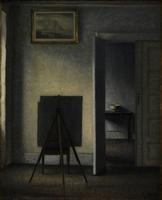
Interior with the Artist's Easel
Vilhelm Hammershoi
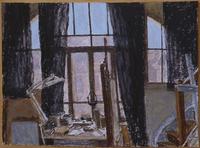
Studio Window with curtains
Avigdor Arikha
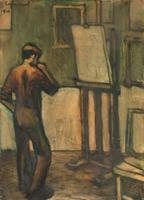
Efry József, Műteremben 1910
Egry József
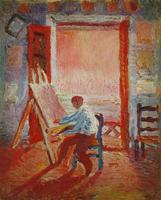
Self-Portrait in the Studio
Salvador Dali
Studio Interior
Henri Matisse
Ivan Shishkin and A. Guinet in the studio on the island of Valaam
Ivan Shishkin
Self-portrait on an Easel in a Workshop
Annibale Carracci
The sisters Schwartz
Anders Zorn
Kwiaty na biurku.
Czesław Jan Pyrgies
The Painter 1928
Wojciech Weiss
The studio on Seguier street
Raoul Dufy
Pracownia artysty z kwiatami i obrazem
Czesław Jan Pyrgies
Frederick and Jessie Etchells Painting
Vanessa Bell
Autumn Gold
Tetyana Yablonska
In Atelier
Olga Boznańska
In the Workshop
Oleg Holosiy
School of painting at the Academy
Michele Cammarano
Sem título
Menez