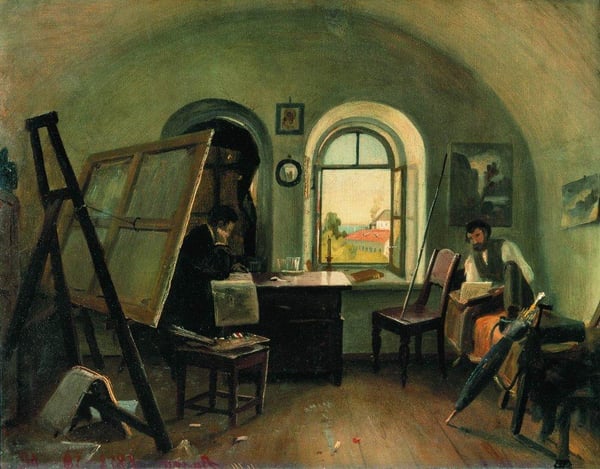
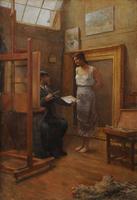
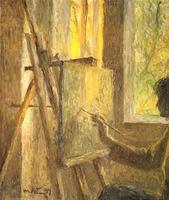
Analysis of "Ivan Shishkin and A. Guinet in the studio on the island of Valaam" (Ivan Shishkin)
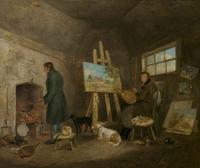
As a work of 19th-century Russian Realism, this genre painting holds particular significance for its rare, self-referential glimpse into the artist’s own creative process. Unlike Shishkin’s more famous monumental landscapes (e.g., Morning in a Pine Forest), here he turns his realist lens inward, documenting the intimate studio environment itself. The presence of fellow painter A. Guinet anchors the scene in the shared, collaborative ethos of the Russian peredvizhniki (Wanderers) movement, which championed truth to life and direct observation.
The setting—Valaam Island, a frequent subject for Shishkin—is key. By showing the studio on location, Shishkin underscores the Realist commitment to plein air study and the authentic encounter with nature. The painting thus functions as both a document of a specific artistic community and a manifesto: the studio is not a detached, academic space but a mobile, engaged workspace embedded in the landscape. This emphasis on the artist’s labor and the material conditions of production distinguishes the work within Shishkin’s oeuvre and within Realist genre painting as a whole.