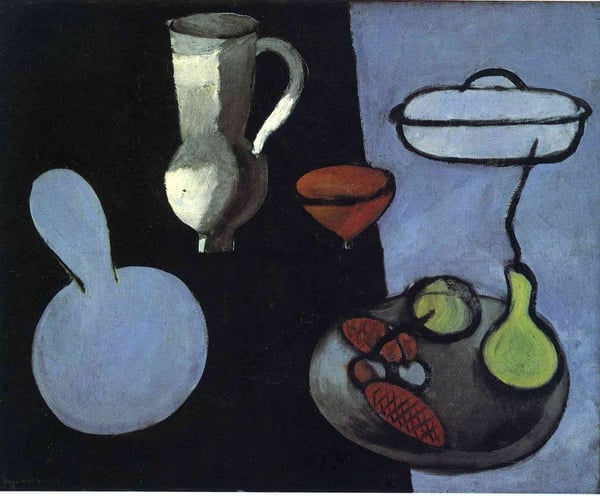
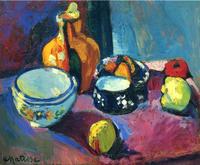
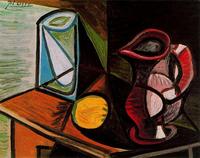
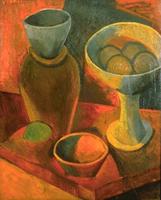
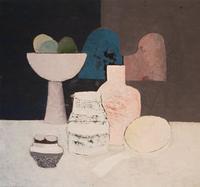
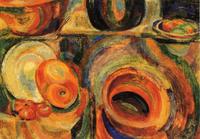
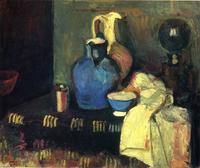
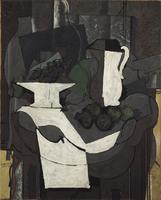
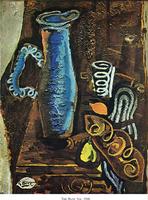
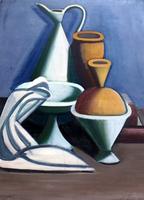
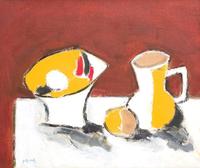
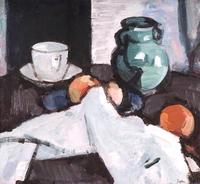
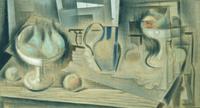
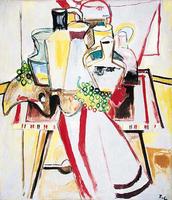
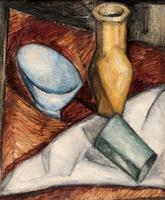
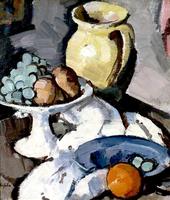
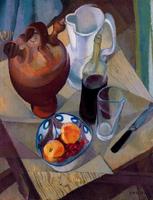
"The Gourds" by Henri Matisse stands as a fascinating intersection of Cubism and Expressionism within the still life genre. While Matisse is most closely associated with Fauvism and his own decorative style, this work demonstrates his engagement with the analytical structure of Cubism—evident in the faceted forms and flattened spatial planes—while retaining the intense, emotional color palette and gestural brushwork of Expressionism. The choice of gourds, a humble and organic subject, allows Matisse to explore formal abstraction without losing the vitality of the natural world. The significance lies in this synthesis: the painting challenges the geometric rigidity of pure Cubism by infusing it with expressive, subjective emotion, and it grounds Expressionist fervor in a disciplined, constructed composition. As a still life, "The Gourds" becomes a laboratory for Matisse’s lifelong pursuit of balancing structure with sensation, marking a key moment where two major modernist movements converge in a single, vibrant object.