Analisi esperta di The Lute di Henri Matisse
Stile: Expressionism · Genere: genre painting
Expert Analysis of "The Lute" by Henri Matisse
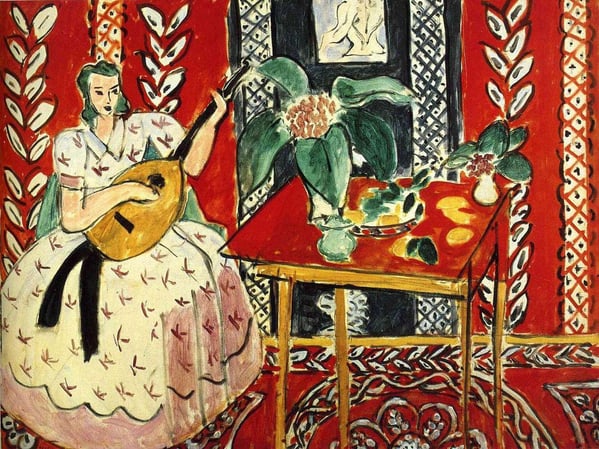
Henri Matisse’s The Lute is a compelling example of early 20th-century Expressionism within the context of genre painting. While Matisse is most famously associated with Fauvism, this work aligns with Expressionism’s core mission: to convey emotional experience through bold distortion, vivid color, and a deliberate departure from naturalistic representation.
Significance within Expressionism:
The Lute exemplifies the Expressionist prioritization of subjective feeling over objective reality. The composition likely features a figure—perhaps a musician or listener—engaged with the lute, a traditional symbol of harmony and artistic creation. Matisse’s treatment of the scene is not merely descriptive; he uses flattened perspective, exaggerated shapes, and a non-naturalistic color palette (e.g., saturated reds, deep blues, and earthy greens) to evoke a mood of introspection or rhythmic vitality. This approach mirrors the Expressionist credo that art should be an emotional revelation, not a mirror of the world.
Genre Painting Context:
As a genre painting—a depiction of everyday life—The Lute transforms a domestic or intimate moment into a vehicle for psychological resonance. Unlike the academic genre works of the 19th century, Matisse’s version strips away anecdotal detail, focusing instead on the interplay of form and color to suggest the sensory experience of music. The lute itself becomes a formal anchor, its curved body and strings echoing the rhythms of line and brushstroke.
Why It Matters:
The Lute is significant because it bridges Matisse’s Fauvist roots with a more introspective Expressionism, showing how a master of color could use genre subjects to explore emotional depth. It challenges the viewer to see beyond the surface—the lute is not just an instrument but a conduit for feeling, rendered through the artist’s own expressive language. In this way, the work stands as a testament to the early modern belief that even the simplest scene can hold profound inner life.
Museum / Gallery
Visivamente simili
20 opere con composizione e palette affini
Woman
Henri Matisse
Le Tabac Royal
Henri Matisse
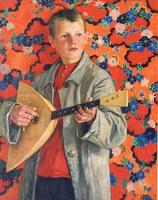
Balalaika Player
Nikolay Bogdanov-Belsky
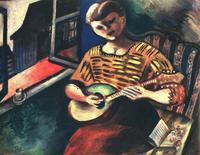
Lisa with a Mandolin
Marc Chagall
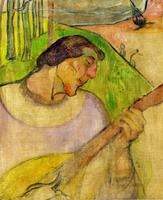
Self portrait with mandolin
Paul Gauguin
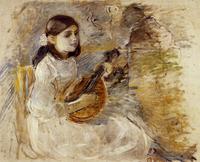
Girl Playing the Mandolin
Berthe Morisot
Woman with Guitar
Aristarkh Lentulov
David in profile
Marc Chagall
Jeune Femme à la Mandoline
Jean Metzinger
Portret Van Guus Van Dongen Door
Isaac Israels
Woman with mandolin
Henri Matisse
The Musician
Paul Guiragossian
Mask and Mandolin
Bela Czobel
The Cobza Player from Balchik
Francisc Sirato
Mandolin on a chair
Paul Gauguin
Odalisque with Mandoline
Iosif Iser
Tatar Woman With Mandoline
Iosif Iser
A Renaissance Dream
Mily Possoz
Stacy Pace Karnival
Stacy Pace
Boy with Balalaika
Nikolay Bogdanov-Belsky