Analisi esperta di Pottery Painting di Sir Lawrence Alma-Tadema
Stile: Romanticism · Genere: genre painting
Expert Analysis: "Pottery Painting" by Sir Lawrence Alma-Tadema (Romanticism, Genre Painting)
Though Alma-Tadema is more commonly aligned with Neoclassicism and Victorian classicism, within the framework of Romanticism this work exemplifies the movement’s fascination with exotic, idealized historical settings and intimate, sensory details that evoke a lost world of beauty.
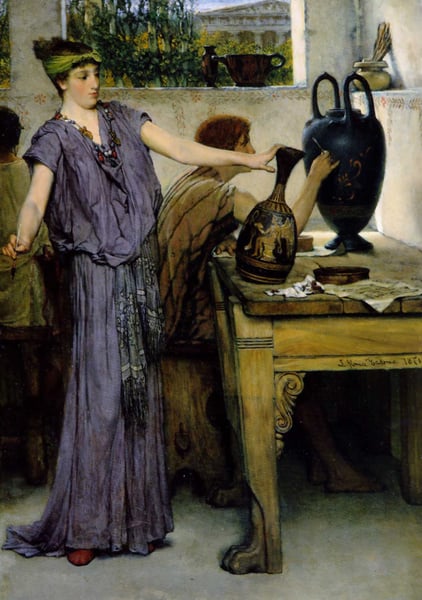
The painting depicts a woman engaged in the quiet, skilled act of decorating a ceramic vessel—a quintessential genre scene lifted from "everyday life" but transported to a romanticized ancient past. Alma-Tadema’s hallmark archaeological precision (the accurate pottery shapes, drapery, and domestic implements) serves not documentary realism but rather a Romantic longing for a harmonious, aesthetic existence. The soft light, the absorbed expression of the figure, and the delicate touch of brush on clay transform a simple craft into a meditative ritual.
Significance within Romanticism:
- Elevation of the domestic and the artisanal – Romanticism often celebrated the individual’s connection to creativity and nature. Here, the anonymous potter-painter becomes a vessel of timeless artistic devotion, merging human skill with the beauty of classical forms.
- Atmosphere and emotion – The quiet concentration and warm glow create a mood of peaceful, almost reverent creativity, emphasizing the Romantic ideal of art as a spiritual and emotional pursuit.
- Historical escapism – Alma-Tadema’s work provided 19th-century viewers a nostalgic escape into a pristine, elegant antiquity—a core Romantic impulse to seek meaning in a pre-industrial, idealized past.
In essence, Pottery Painting is significant for how it uses genre painting to imbue a humble scene with Romantic grandeur, making the act of creation itself a subject worthy of timeless reverence.
Genere
Stile
Visivamente simili
20 opere con composizione e palette affini
Between Hope and Fear
Sir Lawrence Alma-Tadema
The Soldier of Marathon
Sir Lawrence Alma-Tadema
The Household Gods
John William Waterhouse
The Old, Old Story
John William Godward
A Silent Greeting
Sir Lawrence Alma-Tadema
Catullus at Lesbia's house
Sir Lawrence Alma-Tadema
His Birthday Gift
John William Godward
A greek woman
Sir Lawrence Alma-Tadema
Diogenes
John William Waterhouse
Bacchanale
Sir Lawrence Alma-Tadema
Seller of Vases
Henryk Siemiradzki
Two greek women at a fountain
Henryk Siemiradzki
A Bacchic Dance
Sir Lawrence Alma-Tadema
El Pedagogo (Aspasia y Pericles)
José Garnelo
At the Garden Shrine, Pompeii
John William Godward
Autumn
John William Godward
The Siesta
Sir Lawrence Alma-Tadema
Leisure Hours
John William Godward
Reading the Story of Oenone
Francis Davis Millet
The Roman Wine Tasters
Sir Lawrence Alma-Tadema