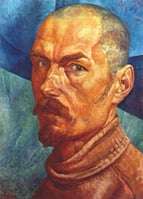
Analisi esperta di Samarkand di Kuzma Petrov-Vodkin
Stile: Symbolism · Genere: landscape
Artwork Analysis: "Samarkand" by Kuzma Petrov-Vodkin
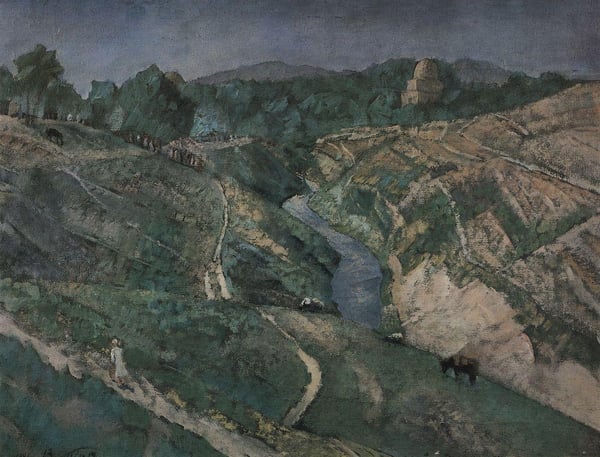
Kuzma Petrov-Vodkin’s Samarkand stands as a luminous testament to the artist’s unique fusion of Symbolist introspection and modernist spatial theory. While nominally a landscape, the work transcends mere topography to become a vision of cosmic harmony and cultural synthesis.
Significance within Symbolism and Petrov-Vodkin’s Oeuvre:
First, the painting exemplifies Petrov-Vodkin’s radical rejection of linear perspective in favor of his own “spherical perspective.” Here, the horizon curves upward, drawing the eye into a vast, tilted panorama that suggests the Earth as a living orb. This technique disorients and elevates the scene, transforming the ancient city of Samarkand into a microcosm of the universe—a key Symbolist goal: to depict the spiritual essence behind visible reality.
Second, the color palette is deliberately symbolic. Petrov-Vodkin employs his signature “three-color principle” (red, blue, yellow) to infuse the landscape with emotional and mystical weight. The intense blues of Central Asian tiles, the warm ochres of sandy domes, and the crimson accents of distant hills create a chromatic vibration that feels both dreamlike and sacred. For the artist, color was not descriptive but expressive—a tool to evoke the sublime.
Third, Samarkand reflects Petrov-Vodkin’s fascination with Eastern iconography and Russian icon painting. The flattened pictorial space, the gold-like yellows, and the reverence for architectural silhouette recall medieval icons, yet the work is palpably modern through its fractured, almost cubist planes. This synthesis makes the painting a bridge between Russia’s Orthodox past and the avant-garde present, a hallmark of Petrov-Vodkin’s mature style.
Finally, the subject itself—Samarkand, a legendary Silk Road crossroads—is loaded with Symbolist meaning. It represents the meeting of cultures, the eternal passage of time, and the resilience of beauty amid decay. Petrov-Vodkin’s landscape becomes a meditation on transcendence through place : the city is not merely observed but experienced as a spiritual essence.
In short, Samarkand is significant because it distills Petrov-Vodkin’s entire artistic philosophy: a world seen through a spherical lens, painted with symbolic color, and haunted by the tension between material surface and metaphysical depth. It is a masterpiece of Russian Symbolist landscape—where geography becomes poetry, and pigment becomes prayer.
Visivamente simili
20 opere con composizione e palette affini
Egry József, Besnyői Táj
Egry József
Landscape with Stream
Robert Lewis Reid

Olives in Spain
Augustus John

The Tiber at Acqua Acetosa
Amedeo Bocchi
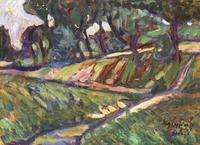
Egry József, Besnyői Táj, ,
Egry József

Chukhururd
Vajiha Samadova
Vertiente en el río
Jose Maria Velasco
Valley Verde in Crepuscule
Henri Martin
The Winding Brook
John Henry Twachtman
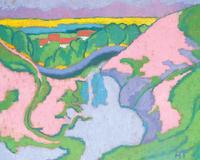
A Landscape of Brasov
Janos Mattis-Teutsch
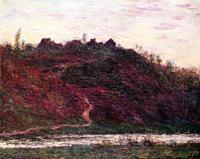
The Village of La Coche-Blond, Evening
Claude Monet

The Promenade du Poussin (Roman Campagna)
Camille Corot
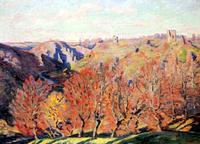
Les Ruines a Crozant
Armand Guillaumin

Ravine near Branchville
Julian Alden Weir
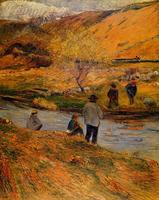
Breton Fisherman
Paul Gauguin
Landscape at Wargemont
Pierre-Auguste Renoir
River in Menshov
Konstantin Korovin
Garden at Văratec
Horia Bernea

The Quarry, Pontoise
Camille Pissarro

Barranca del Agua Santa
Jose Maria Velasco