Analisi esperta di Betrayal in the Garden of Gethsemane di Ilya Repin
Stile: Realism · Genere: sketch and study
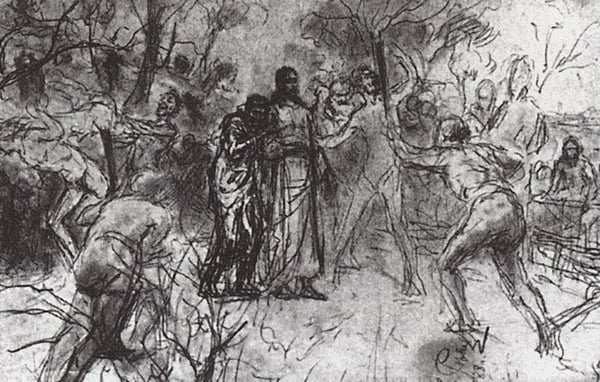
This is an expert analysis of Ilya Repin’s “Betrayal in the Garden of Gethsemane”, based on the provided facts. The artwork is a sketch and study executed in the Realism style.
Expert Analysis:
Ilya Repin’s “Betrayal in the Garden of Gethsemane” holds its significance not as a finished narrative painting, but as a revealing window into the working method of one of Russia’s greatest Realist masters. As a sketch and study, it strips away the theatrical grandeur often associated with biblical scenes, focusing instead on the raw, psychological moment of betrayal with an almost documentary immediacy.
Significance within Russian Realism and the Sketch Genre:
-
Psychological Realism over Religious Iconography: Repin, a leader of the Peredvizhniki (The Wanderers) movement, was committed to depicting truth and human emotion without idealization. In this study, he bypasses traditional iconographic symbols (halos, dramatic clouds) to capture the intense, intimate drama. The focus is on the human reactions: the tension in Judas’s approaching figure, the exhaustion and sorrow in Christ’s posture, and the chaotic sleep of the disciples. This aligns perfectly with Realism’s goal of portraying life as it is—even in a biblical context, it becomes a scene of human conflict.
-
Mastery of Light and Shadow as a Narrative Tool: As a study, Repin experiments with chiaroscuro to heighten the emotional stakes. The garden’s darkness is punctuated by the flickering torchlight from the approaching mob, casting sharp, unsettling shadows. This is not merely decorative; it visually fractures the scene, mirroring the spiritual fracture of the moment. The light falls mercilessly on Christ’s face, while Judas’s face is half-hidden, emphasizing the duplicity of his kiss.
-
Preparatory Energy and Authenticity: The sketch genre allows us to see Repin’s process. The loose, vigorous brushstrokes in the figures of the disciples and the soldiers in the background demonstrate a search for the most authentic gesture. This unfinished quality is significant because it reveals the artist’s struggle to capture a fleeting, emotionally charged instant—a hallmark of Repin’s method. Unlike a polished painting, which can feel composed, this study retains the rawness of a first-hand observation, as if Repin himself were a witness in the garden.
-
Contextual Innovation: For Repin, painting a religious subject was a bold departure from his usual social critiques (e.g., Barge Haulers on the Volga). By treating the Betrayal with the same gritty Realism he applied to contemporary Russian life, he demystified a sacred story, making it accessible and deeply human. This study shows how he approached the scene with the same objective eye he would use for a peasant or a political rally, bridging the gap between religious tradition and modern artistic truth.
In summary, this sketch is significant because it captures Repin at his most investigative: using the Realist toolkit—honest emotion, dramatic lighting, and spontaneous mark-making—to explore the universal themes of trust, betrayal, and human frailty, all within the intimate confines of a preparatory study.
Visivamente simili
20 opere con composizione e palette affini
The murderers carry the body of Fualdes
Théodore Géricault
Apollo and the Nine Muses Surrounded by Poets on Mount Parnassus
Karel Škréta
Allegory of Fertility
Jacob Jordaens
The Embarkation of the Souls
Gustave Dore
Don Quixote
Gustave Dore
The Blasphemers--Capaneus
Gustave Dore
Forgers II
Gustave Dore
The Inferno, Canto 13
Gustave Dore
Blow
Francisco Goya
Sower of Discord
Gustave Dore
Bathers
Paul Cezanne
Carrying the Cross
Vilmos Aba-Novak
Bathers
Paul Cezanne
The Greeks Leave after Fire of Troy
Theodoor van Thulden
Apostles group
Titian
The Inferno, Canto 28
Gustave Dore
Diana and Actaeon
Bartholomeus Spranger
The Battle of Love
Paul Cezanne
The bathers
Rembrandt
Khlysty zeal. Sketch
Vasily Perov