Analisi esperta di Apostles group di Titian
Stile: High Renaissance · Genere: sketch and study
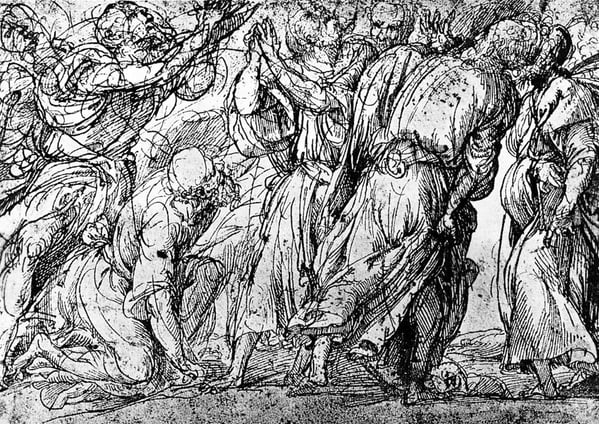
This artwork is a remarkable testament to the creative process of one of the High Renaissance's greatest masters. As a sketch and study for an "Apostles group," Titian’s work offers a rare glimpse into the artist's preliminary thinking—the very moment when a grand composition begins to take shape.
Significance within the High Renaissance:
While the High Renaissance is often celebrated for its perfected, monumental finished works (like those of Raphael or Leonardo), Titian's study underscores the period's deep intellectual rigor. Such sketches were not mere warm-ups; they were the laboratories of invention. Here, Titian explores the dynamic grouping of multiple figures—likely for a sacra conversazione or a Last Supper scene. The loose handling of line and shadow reveals his focus on disegno (the intellectual design) and the expressive power of gesture. Each apostle’s pose would be carefully differentiated to convey distinct emotions, from doubt to awe, embodying the Renaissance ideal of capturing the human soul through physical form.
What makes it significant:
-
Window into Titian’s method: Unlike the polished surfaces of his altarpieces, this sketch shows Titian reasoning through spatial relationships. The rapid, searching strokes—typical of his Venetian workshop—demonstrate his preference for tonal building over rigid contour lines, a key difference from his Florentine contemporaries.
-
Frozen narrative: The "Apostles group" is a study in collective psychology. Even in sketch form, Titian arranges heads and hands to create a subtle narrative tension, preparing for the dramatic chiaroscuro and colorism that would define his mature style.
-
Genre importance: As a sketch and study, this work highlights the evolving status of preparatory drawings in the 16th century. They were prized as autonomous works of genius, foreshadowing the later celebration of the non-finito (unfinished). For Titian, the sketch was where spontaneity met structure—a core principle of the High Renaissance ideal of sprezzatura (effortless mastery).
In short, this seemingly modest sheet is a vital piece of the puzzle, revealing how a High Renaissance master translated divine narrative into human, expressive form.
Museum / Gallery
Visivamente simili
20 opere con composizione e palette affini
Betrayal Of Christ
Albrecht Durer
The Sacrifice of Elijah Against the Prophets of Baal
Luca Giordano
Adoration of the Magi
Giovanni Battista Piranesi
Arrest of Christ
Albrecht Durer
The Entombment
Andrea Mantegna
Burning of Dulcin and His Wife, Novarra, AD 1308
Jan Luyken
La cacciata dei mercanti dal tempio
Giulio Benso
Stoning of Stephen, AD 34
Jan Luyken
Apollo and the Nine Muses Surrounded by Poets on Mount Parnassus
Karel Škréta
A Scene of Exodus with Women and Children Resting
Adam van Noort
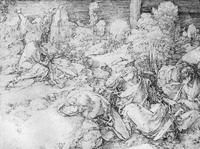
Christ on the Mount of Olives
Albrecht Durer
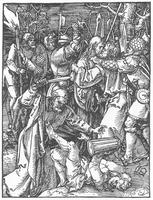
Christ Taken Captive
Albrecht Durer
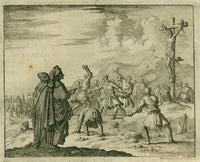
Crucifixion of Apostle Matthew, AD 70
Jan Luyken
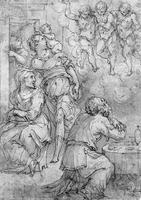
Abraham and the Three Angels
Giorgio Vasari
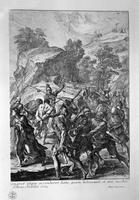
Jesus carried to Calvary
Giovanni Battista Piranesi
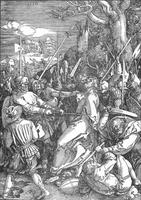
Christ Taken Captive
Albrecht Durer
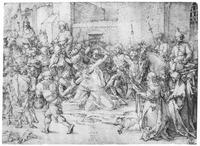
The Cross of Christ with Saint Veronica
Albrecht Durer
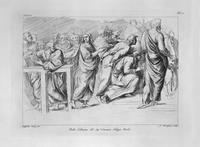
Detail of the Dispute of the Sacrament of Raphael
Giovanni Battista Piranesi
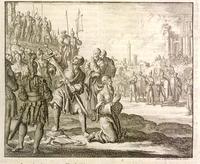
Apostle Paul Beheaded, Rome, AD 69
Jan Luyken
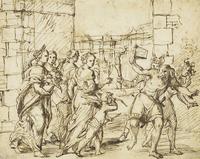
The Lupercalian Festival in Rome. Cupid and Personifications of Fertility Encounter the Luperci Dressed as Dogs
Adam Elsheimer