Análisis experto de Calvary (Crucifixion) de Ilya Repin
Estilo: Realism · Género: religious painting
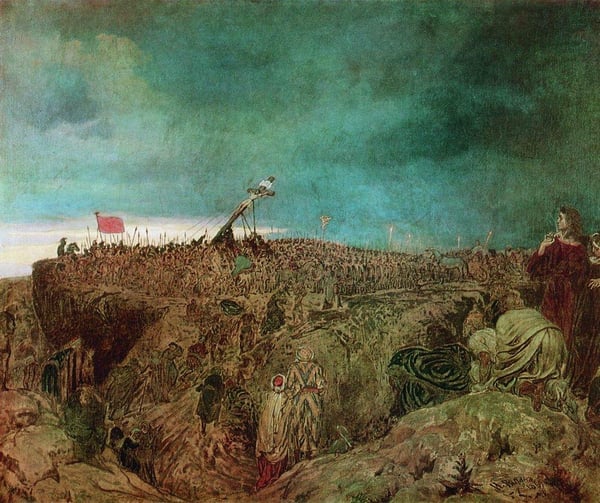
Ilya Repin’s Calvary (Crucifixion) is a powerful example of how Realism—a movement dedicated to depicting life with unflinching truth—could transform a traditional religious subject into a deeply human, almost journalistic, document of suffering. While Repin is best known for his monumental genre scenes and psychological portraits (Barge Haulers on the Volga, Ivan the Terrible and His Son Ivan), his foray into religious painting is significant precisely because it applies the same rigorous observation of human anatomy, emotion, and environment to a biblical scene.
Significance within Realism:
Unlike the idealized, compositionally balanced Crucifixions of the Renaissance or the dramatic, chiaroscuro-laden versions of the Baroque, Repin’s Calvary eschews divine gloss. The work is startling in its physicality: the tortured body of Christ is rendered with clinical attention to the strain of muscles, the weight of the cross, and the grim pallor of exhaustion. Repin focuses on the moment of suffering rather than the promise of resurrection, aligning with Realism’s insistence on the “here and now.” The crowd is not a pious, orderly gathering; it is a chaotic, agitated mass of onlookers, soldiers, and mourners, their faces a study in fear, indifference, grief, and cruelty. This democratization of emotion—giving every bystander a distinct, psychologically plausible reaction—mirrors Repin’s skill in capturing the Russian populace in his secular works.
Genre and Context:
As a religious painting, Repin’s Calvary was controversial in its time. The Russian Orthodox Church and conservative critics often accused him of excessive naturalism, of stripping the Crucifixion of its sacred aura. Yet this is precisely the work’s radical achievement: it makes the scene feel contemporary, a crucifixion that could occur on any dusty hill under a grey, indifferent sky. The palette is muted—ochre, ash, deep brown—eschewing the rich reds and golds of icon painting. The light is somber and diffuse, lacking any miraculous halo or divine beam. This is a Crucifixion seen through the lens of 19th-century skepticism and humanitarian compassion.
Artistic Legacy:
Repin’s portrayal influenced later Russian and European artists who sought to reconcile faith with realism—such as the Russian Wanderers (Peredvizhniki) and, indirectly, the social-critical religious works of Georges Rouault or Käthe Kollwitz. The painting stands as a testament to Realism’s ability to revitalize even the most storied iconography by forcing the viewer to confront the raw, unvarnished agony of the event. It is a Calvary where the divinity is not denied but made palpable through the sheer weight of human pain.
Visualmente similares
20 obras con composición y paleta relacionadas
The Harvest of Battle
C. R. W. Nevinson
The Battle of Tetouan
Marià Fortuny
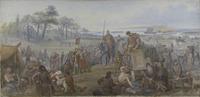
After the Battle of Fyrisvall. Proposed Decoration of the Walls in the Upper Hall of the Nationalmuseum
Mårten Eskil Winge
The Battle of Tetouan
Marià Fortuny
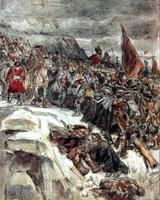
Russian Troops under Suvorov Crossing the Alps (study)
Vasily Surikov
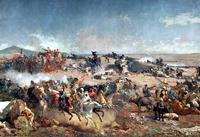
The Battle of Tetouan (detail)
Marià Fortuny
Yermak's conquest of Siberia (study)
Vasily Surikov
Prince Eugene of Savoy at the Battle of Zenta
Anton Romako
The Battle of Tetouan (detail)
Marià Fortuny
The Battle of Wad-Rass
Marià Fortuny
Moses on Mount Sinai
Jean-Leon Gerome
Destruction at Damascus of the Army of Conrad III of Germany
Gustave Dore
Batalha do Avaí
Pedro Américo
Court Pugacheva
Vasily Perov
Two Hundred Knights Attack Twenty Thousand Saracens
Gustave Dore
Gunthram Bose and his daughters: AD 572
Sir Lawrence Alma-Tadema
Interior of the Malakoff with the remains of the round tower
William Simpson
Jan Amos Komensky
Alphonse Mucha
An Episode from the Battle of Tetuán
Eduardo Rosales
Battle of Treviño
Francisco Oller