Analisi esperta di Figure of dancing man di Ilya Repin
Stile: Realism · Genere: sketch and study
Expert Analysis: "Figure of Dancing Man" by Ilya Repin
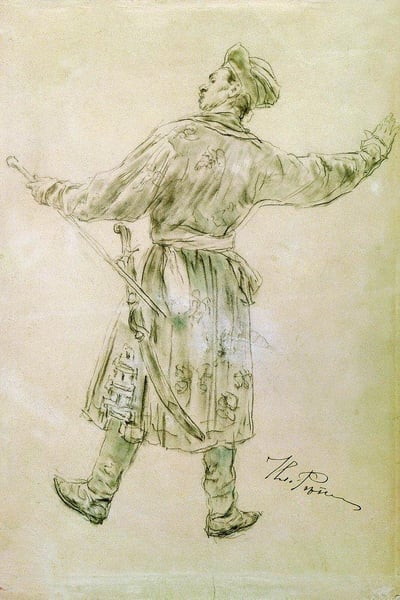
Ilya Repin (1844–1930) stands as the preeminent figure of Russian Realism, a movement that sought to depict the truth of contemporary life with unflinching accuracy and emotional depth. This work, a sketch and study titled Figure of Dancing Man, is a masterclass in capturing transient human motion—a hallmark of Repin’s artistic discipline and a key to understanding his larger narrative paintings.
Significance within Realism and Repin’s Oeuvre
What makes this sketch significant is its role as a preparatory study—a vital, often overlooked stage in the Realist process. Unlike finished canvases that present a polished narrative, studies like this reveal the artist’s raw investigation of anatomy, weight distribution, and kinetic energy. Repin was known for his exhaustive preparation; for major works such as Barge Haulers on the Volga and Religious Procession in Kursk Province, he created hundreds of individual figure studies from life. This dancing man likely served as a building block for a larger composition, demonstrating how Repin broke down complex social scenes into discrete, authentic gestures.
Stylistic and Technical Observations
In this sketch, Repin employs loose, confident lines that prioritize movement over finish. The figure’s torso twists, arms swing, and one leg lifts—a fleeting gesture frozen in charcoal or graphite. This is not a static, academic pose but a spontaneous re-creation of a folk or tavern dance, typical of Repin’s interest in Russian peasant life and popular culture. The absence of background or elaborate shading forces the viewer to focus on the rhythm of the body, a testament to Repin’s skill in suggesting volume through minimal means. Such études also reflect the Realist commitment to observing actual people in unposed moments, countering the idealized figures of Neoclassicism or Romanticism.
Historical and Artistic Context
Repin’s sketches are prized for their documentary value—they preserve the physicality of 19th-century Russian life. The Figure of Dancing Man connects to Repin’s broader themes: the vitality of the common people, the celebration of spontaneous joy, and the artist’s empathy for his subjects. It also demonstrates how Realism, despite its reputation for seriousness, embraced the dynamism of dance as a subject. Scholars note that Repin’s studies often carry a vigor missing from his more polished works, making them essential for understanding his creative process.
Conclusion
As a sketch, Figure of Dancing Man is significant not despite its incompleteness, but because of it. It offers an unfiltered view into Repin’s method—the rigorous observation that underpinned Russian Realism’s greatest achievements. For art historians, this work exemplifies how a fleeting line can capture the soul of an era: the joy, struggle, and unscripted humanity that defined Repin’s art.
Visivamente simili
20 opere con composizione e palette affini
Yermak with cossacks (Study to "The Conquest of Siberia by Yermak")
Vasily Surikov
The Count of Palatino in the costume of a Palikar
Richard Parkes Bonington
A Polander Turned to the Left
Rembrandt
Captured Pechenegs (Costume design for the opera "Rogneda")
Mikhail Vrubel
Triptych. Cossack with a saber.
Pyotr Konchalovsky
Untitled
Georgyi Yakutovytch
Portrait of a Greek insurgent Theodore Kolokotroni
Karl Bryullov
Illustration to the 'Kobzar' by Taras Shevchenko
Vasyl Sedlyar
Alyosha Popovich. Illustration for the book "Russian epic heroes"
Andrei Ryabushkin
Prince's huntsman (Costume design for the opera "The Enchantress")
Mikhail Vrubel
David's victory over Goliath (I Samuel, XVII, 48, 51)
Marc Chagall
Portrait of P. A. Chikhachev
Karl Bryullov
A Bedouin
John Frederick Lewis
Mizgir
Viktor Vasnetsov
Warrant Officer Hassan-Beck Dzhagranov
Vasily Vereshchagin
Prince Yuri (Costume design for the opera "The Enchantress")
Mikhail Vrubel
Geza
Josef Kriehuber
Kadicha, legendary Hungarian military leader
Josef Kriehuber
Costume Design for the tragedy of Pushkin's Boris Godunov
Kuzma Petrov-Vodkin
Afghan
Vasily Vereshchagin