Expert analysis of Ilya Repin’s Religious Procession
Style: Realism · Genre: genre painting
Expert Analysis of Ilya Repin's "Religious Procession"
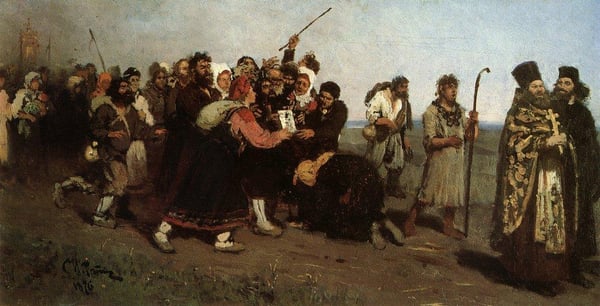
Ilya Repin's "Religious Procession" (often catalogued as "Religious Procession in Kursk Governorate", 1880–1883) stands as a monumental achievement of the Realist movement and a defining work of genre painting in 19th-century Russian art. Repin, the preeminent Russian Realist, uses this massive canvas not merely to document a local religious custom but to deliver a penetrating social critique, making the work profoundly significant within its period.
Significance within Realism and Genre Painting:
-
Unflinching Social Commentary: Repin transforms a seemingly simple religious ritual into a layered cross-section of Tsarist Russian society. The procession is not a harmonious act of faith but a hierarchical spectacle. The priest and wealthy icons are carried aloft, detached from the masses, while a line of peasants, beggars, and disabled individuals trudge through deep dust. A policeman wields a whip to maintain order. This composition starkly exposes the hypocrisy of organized religion and the deep class divisions of the era—a hallmark of critical Realism.
-
Mastery of Observation and Detail: True to the Realist creed, Repin fills the canvas with countless individualized figures. Each face tells a story: the smugness of the landowner, the desperation of the crippled beggar, the drunkenness of a peasant stumbling with an icon, the solemnity of a devout woman. The dust kicked up, the glitter of gold icons against humble homespun, the sweat on brows—all are rendered with a quasi-documentary precision that makes the scene feel alive and immediate.
-
Monumental Scale for a "Low" Subject: By painting a humble genre scene on a grand, history-painting scale (over 17 feet wide), Repin elevated the everyday to the epic. This choice was a radical Realist statement: the struggles and rituals of ordinary people deserved the same artistic weight as classical myths or royal triumphs. It asserts that the truth of Russian life, in all its ugliness and beauty, is the most worthy subject of art.
-
Ambiguous Tone and Lasting Impact: Repin avoids simple moralizing. The work is neither fully celebratory nor entirely condemning. The faithful include both sincere believers and cynical exploiters. This ambiguity forces the viewer to confront the complex role of religion in a society marked by poverty and authority. The painting became an immediate sensation, praised for its technical bravura and condemned for its perceived attack on the Church, solidifying Repin's role as both a master painter and a fearless social chronicler.
In summary, "Religious Procession" is significant because it encapsulates the very essence of Realism: an artist's dedication to truth, a critical eye on society, and a deep empathy for the human condition—all delivered through breathtaking, painstaking craft. It remains a cornerstone of Russian Realist genre painting, a vivid document of its age, and a timeless meditation on faith, power, and human suffering.
Genre
Style
Visually similar
20 works with related composition and palette
Zaporozhtsy
Ilya Repin
Весілля в Київській губернії
Микола Пимоненко
The Reply of the Zaporozhian Cossacks to Sultan Mehmed IV
Ilya Repin
Prayer in time of drought
Grigoriy Myasoyedov
The Reply of the Zaporozhian Cossacks to Sultan Mahmoud IV
Ilya Repin
Beggars near the Church
Ivan Tvorozhnikov
The development of new lands by Russian
Klavdy Lebedev
Arrival tsars Piotr and Ioann
Ilya Repin
Easter Procession in a Village
Vasily Perov
Child Funeral
Konstantin Makovsky
Singing Beggars (Pilgrims)
Viktor Vasnetsov
St. Nicholas Saves Three Innocents from Death
Ilya Repin
Nicholas of Myra eliminates the death of three innocent prisoners
Ilya Repin
Dancing
Klavdy Lebedev
Rus: The Soul of the People
Mikhail Nesterov
Traditional Swedish dance
August Malmstrom
Return of the Father from the Fair
Alexei Korzukhin
Burial of a Kish Otaman
Oleksandr Murashko
Martha the Mayoress. Destruction of Novgorod by Ivan III.
Klavdy Lebedev
The Third of May 1808 (Execution of the Defenders of Madrid)
Francisco Goya