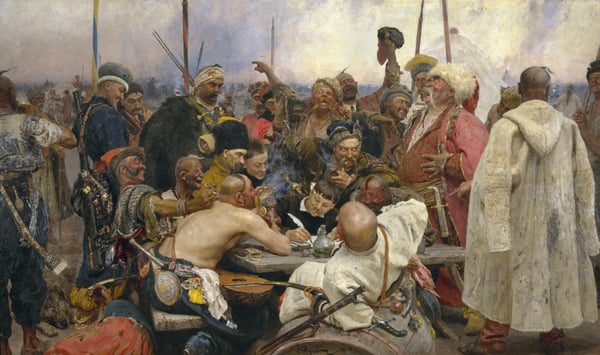
The Reply of the Zaporozhian Cossacks to Sultan Mehmed IV
Details
Expert analysis of Ilya Repin’s The Reply of the Zaporozhian Cossacks to Sultan Mehmed IV
Style: Realism · Genre: history painting
Expert Analysis: "The Reply of the Zaporozhian Cossacks to Sultan Mehmed IV" by Ilya Repin
As a landmark of Realism executed within the grand tradition of history painting, this work achieves significance by radically democratizing a historical narrative. Repin applies the Realist mandate—truthful observation of everyday life and unidealized human expression—to a subject traditionally reserved for heroic, allegorical, or mythological treatment. Instead of depicting a solemn diplomatic exchange, he captures a raucous, irreverent moment of communal laughter and defiant letter-writing.
What makes it significant within its style and genre:
-
Realism’s elevation of the “folk” – The painting rejects the polished, heroic figures of academic history painting. Every Cossack is rendered with meticulous, unflinching detail: weathered faces, ribald grins, and spontaneous, varied poses. Repin’s Realist eye focuses on authentic, fleeting human reactions—a smirk, a belly laugh, a tilted hat—rather than idealized nobility. This grounds the historical event in tangible, living experience.
-
History painting as collective character study – Traditionally, history painting prioritized a singular heroic action. Repin transforms the genre into a vibrant, multi-character drama. The composition is deliberately crowded, with no single protagonist. Instead, the “reply” itself becomes the collective voice of a people, framed as a democratic, even anarchic, gesture. The canvas reads as a cross-section of Cossack society, from elderly scribes to young warriors, all bound by shared mockery.
-
Psychological immediacy – Repin’s Realist technique—broad, energetic brushwork and a palette of earth tones punctuated by bright whites and reds—creates an almost photographic sense of present tense. The viewer feels as if they have stumbled upon this private moment. This psychological intimacy, a hallmark of Repin’s Realism, redefines history painting not as distant epic but as a living, breathing tableau.
-
Subversion of power through laughter – Within the genre’s usual framework of moral or political lessons, Repin offers a subversive statement. The Cossacks’ unbridled laughter is a political act, turning a historical confrontation into an assertion of cultural identity and irreverent defiance. Realism allows this emotion to feel raw and spontaneous, not staged.
In sum, the painting’s significance lies in its successful fusion of Realism’s commitment to everyday truth with the narrative scope of history painting. Repin proves that the most profound historical moments can be captured not through grandeur, but through the unvarnished, human reaction of ordinary people.
Museum / Gallery
Visually similar
20 works with related composition and palette
The Reply of the Zaporozhian Cossacks to Sultan Mahmoud IV
Ilya Repin
Zaporozhtsy
Ilya Repin
Religious Procession
Ilya Repin
Arrival tsars Piotr and Ioann
Ilya Repin
The development of new lands by Russian
Klavdy Lebedev
Bathory at Pskov
Jan Matejko
St. Nicholas Saves Three Innocents from Death
Ilya Repin
Nicholas of Myra eliminates the death of three innocent prisoners
Ilya Repin
The Third of May 1808 (Execution of the Defenders of Madrid)
Francisco Goya
Весілля в Київській губернії
Микола Пимоненко
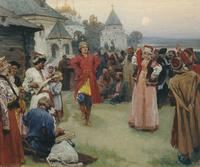
Dancing
Klavdy Lebedev
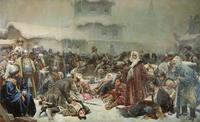
Martha the Mayoress. Destruction of Novgorod by Ivan III.
Klavdy Lebedev
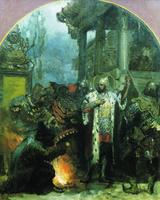
Prince Alexander Nevsky in Gold Horde
Henryk Siemiradzki
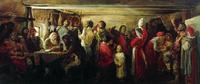
Village Wedding in the Tambov Province
Andrei Ryabushkin
The Wounded Montenegrin
Paja Jovanovic
Jan Suchorzewski
Jan Matejko
Yermak's conquest of Siberia
Vasily Surikov
Burial of a Kish Otaman
Oleksandr Murashko
Gunthram Bose and his daughters: AD 572
Sir Lawrence Alma-Tadema
Rus: The Soul of the People
Mikhail Nesterov