Analisi esperta di Wounded man di Ilya Repin
Stile: Realism · Genere: portrait
Expert Art Historical Analysis of "Wounded Man" by Ilya Repin
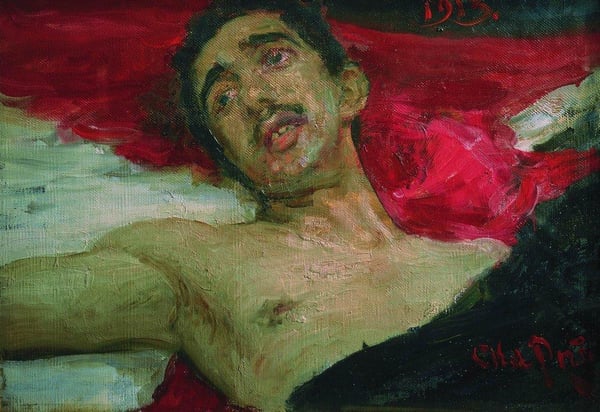
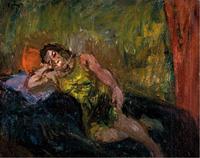
Ilya Repin’s "Wounded Man" stands as a powerful exemplar of Russian Realism in the late 19th century, a movement that rejected academic idealization in favor of unflinching truth. As a portrait, the work transcends mere likeness to become a profound study of human suffering and resilience.
Significance within Realism and the Portrait Genre:
- Raw Emotional Honesty: Repin captures the immediate aftermath of violence with clinical precision. The subject’s pallor, slackened posture, and the subtle sheen of sweat or blood on the skin evoke a visceral sense of shock and exhaustion. There is no heroic grandeur—only the stark reality of a body in trauma.
- Social Commentary: Repin, deeply influenced by the anti‑tsarist populist movement, often depicted figures on the margins. This wounded man likely represents the countless soldiers or ordinary citizens crushed by war or oppression. By elevating a single anonymous victim to the dignity of a portrait, Repin implicitly critiques the systems that produce such casualties.
- Mastery of Psychological Depth: In the realist tradition, the face and eyes become the focal point. Repin renders the gaze hollowed by pain, the brow furrowed not just by physical agony but by a weary understanding. This interiority turns the portrait into a narrative—a frozen moment that asks the viewer to imagine the battle or accident that led here.
- Technical Innovation: Repin’s brushwork combines loose, expressive strokes (especially in the clothing and background) with meticulous detail in the face and wound, drawing the eye unerringly to the center of pathos. The muted palette of grays, browns, and dull reds reinforces the somber mood, while the subtle play of light models the skull and emphasizes the vulnerability of the human form.
What Makes It Enduring:
"Wounded Man" is not merely a record of pain but a testament to realism’s core belief: that art’s highest purpose is to reveal truth, however uncomfortable. Repin’s refusal to sentimentalize or glorify his subject forces an empathetic confrontation with mortality. In doing so, the portrait achieves a universality—it speaks to the cost of every conflict and the fragility of all bodies, making it a timeless piece of humanitarian witness.
Museum / Gallery
Visivamente simili
20 opere con composizione e palette affini
Fauno
Magnus Enckell
Last Portrait of Leigh
Lucian Freud
Bacchant
Magnus Enckell
Czobel Bela Pihenö Nő
Bela Czobel
Fragment of a Self-Portrait
Richard Gerstl
Girl's torso
Eliseu Visconti
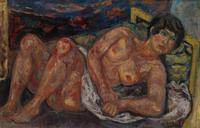
Reclining Nude
Pinchus Kremegne
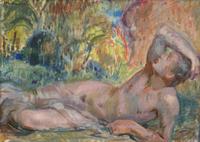
The Dying Adonis
Magnus Enckell
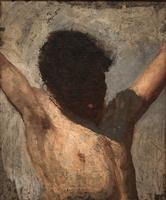
Sketch for the Crucifixion
Thomas Eakins
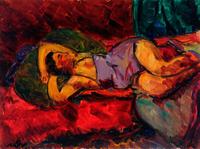
Reclining Nude. The Mauve Chemise
Matthew Smith
Half-naked child
Polychronis Lembesis
Naked Portrait
Lucian Freud

Nude Study
Henry Herbert La Thangue
Girl with closed eyes
Lucian Freud
Félakt
Bela Czobel
Nude
Bela Czobel
Model Turning
Matthew Smith
Dancer at the Moulin Rouge
Jules Pascin
Young Bather
Gandy Brodie
Berény Róbert, Pihenő Lány,
Berény Róbert