
Description
Style: Impressionism · Genre: genre painting
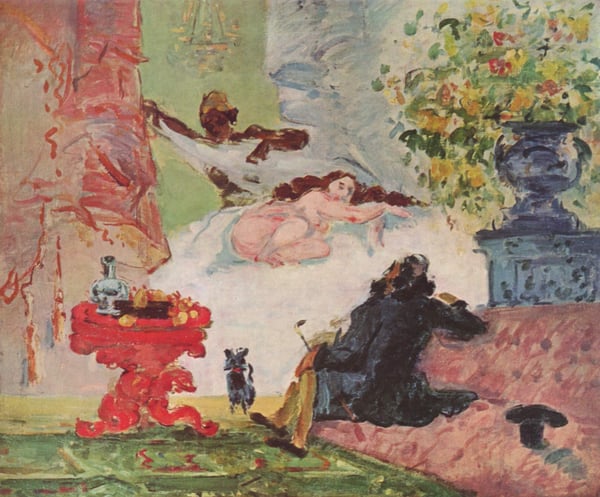
A Modern Olympia (1874) by Paul Cézanne was an homage to Édouard Manet’s painting Olympia (1863) that caused a great scandal when it was first exhibited at the 1865 Paris Salon. Manet’s Olympia shows a nude woman lying on the bed while a servant brings her flowers. It was modeled after the painting Venus of Urbino (ca. 1534) by [url href=www.wikiart.org/en/artists-by-art-movement/high-renaissance]Renaissance[/url] painter Titian. However, Manet’s Olympia was not a Roman goddess, and a contemporary audience was able to unequivocally identify her as a prostituted woman. In the 19th century Paris ‘Olympia’ was a slang word for 'prostitute', and Manet revealed his model’s identity through several details in the painting: the contemporary accessories symbolized wealth and sensuality, the black cat was a symbol of prostitution and above all the gaze of the model confronted the viewer directly. The painting broke with academic tradition and convention by rejecting the idealized nude that represented historical or mythical figures. Despite the controversy, Olympia was greatly admired by artists Claude Monet and Paul Cézanne, as well as by writer Émile Zola.
The idea for A Modern Olympia came about during Cézanne’s stay with Doctor Paul Gachet at Auvers-sur-Oise. Cézanne had a burst of inspiration amid a heated discussion, during which he sketched out the adaptation of Manet’s painting. In the painting, Cézanne used luminous and bright colors and was painted in an Impressionist manner. Cézanne’s interpretation A Modern Olympia was exhibited in the first Impressionist exhibition in 1874 and was poorly received by both the public and critics. In an art review, critic Marc de Montifaud wrote: “like a voluptuous vision, this artificial corner of paradise has left even the most courageous gasping for breath … and Mr. Cézanne merely gives the impression of being a sort of madman, painting in a state of delirium tremens”.
Even though Cézanne included all the main elements of Manet’s painting, the nude woman, a black servant, a curtain, a large bouquet of flowers, and a small pet, the result was very different. Cézanne also made an important addition to the composition, a male figure reclining on the couch dressed in black, elegant attire. By restaging the scene Cézanne made it more explicit: the black maid uncovers the nude woman like in peep show designed for the client, the man on the couch. The gesture of the reveal is reminiscent of Jean-Léon Gérôme’s Phryne before the Areopagus (1861), a painting that depicts the trial of Phryne, a legendary courtesan from ancient Greece. Another important difference was in Cézanne’s depiction of Olympia: lying on the bed in a crouched pose, she has no recognizable facial features or characteristics. Painted crudely, Cézanne’s ‘modern Olympia’ is an archetypal figure, that does not possess the erotic appeal of Manet’s female nude. The erotic quality of Cézanne’s painting comes from the unseemly activity he explicitly depicts, rather than the sensuous flesh of the naked woman. Cézanne’s painting is theatrical, the curtain on the left side makes the scene appear like a moment captured on the stage. Today, Olympia and A Modern Olympia both belong to the collection of Musée d'Orsay in Paris.
Museum / Gallery
Visually similar
20 works with related composition and palette
A Modern Olympia
Paul Cezanne
Afternoon in Naples
Paul Cezanne
Olympia
Paul Cezanne
Bacchante
Joaquín Sorolla
In the Hotel Room
Jules Pascin
The Salon of Madame Aron
Edouard Vuillard
Odalisque, Harmony in Red
Henri Matisse
Spirit of the Garden
Robert Lewis Reid
Nude Woman on a Bed
Vincent van Gogh
Resting Bacchante
Joaquín Sorolla
Salon
J.M.W. Turner
Brothel on the Rue des Moulins Rolande
Henri de Toulouse-Lautrec
Mother and Child
Lovis Corinth

The sun's rays
Hovsep Pushman
The Model Waking
Matthew Smith
Nude Standing before a Mirror
Henri de Toulouse-Lautrec
Rolla
Henri Gervex
The Arabian
James McNeill Whistler

Nude
Volodymyr Bondarenko
Eastern dance
Mikhail Vrubel