Экспертный разбор работы «Olympia» художника Paul Cezanne
Стиль: Impressionism · Жанр: genre painting
Expert Analysis: "Olympia" by Paul Cézanne
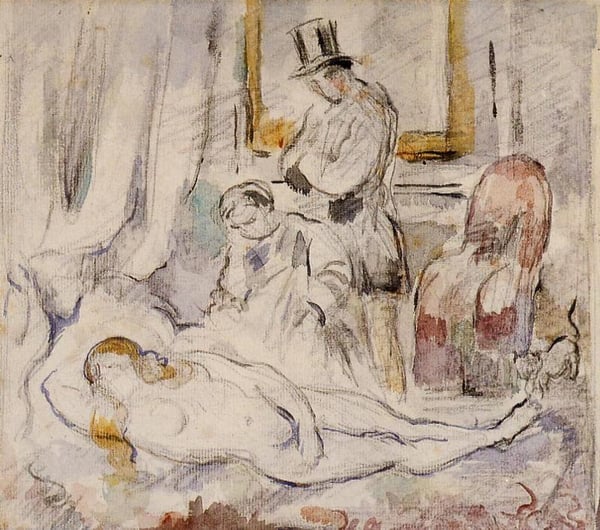
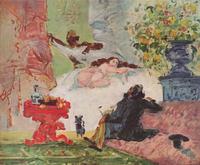
Despite the immediate association of the title “Olympia” with Édouard Manet’s landmark 1863 painting, Paul Cézanne’s version—executed during his Impressionist period—is a fascinating reinterpretation that underscores the artist’s restless formal experimentation. Within the framework of Impressionism and the genre painting tradition, Cézanne’s “Olympia” repositions a modern, confrontational nude figure in a domestic interior, but his handling of color, brushwork, and spatial compression reveals the seeds of his later, more structurally rigorous style.
Significance within its Style and Period:
-
Impressionist Dialogue and Departure: Cézanne’s “Olympia” retains the hallmark Impressionist commitment to contemporary subject matter, capturing light and atmosphere through broken, visible brushstrokes. However, unlike the more optically focused works of Monet or Renoir, Cézanne uses these strokes to build volumetric mass—the figure feels solid, almost carved from pigment, rather than dissolved in light. This tension between fleeting sensation and underlying structure is a hallmark of Cézanne’s early Impressionist phase and anticipates his pivotal role as a bridge to Post-Impressionism.
-
Reinvention of a Scandalous Icon: By reworking Manet’s infamous reclining nude, Cézanne engages directly with one of the 19th century’s most provocative paintings. Yet his version is less about shocking the bourgeoisie and more about exploring spatial and formal relationships. The figure’s pose, with her hand placed similarly to Manet’s Olympia, is rendered with a deliberate awkwardness—flattened perspective, uneven anatomy, and a dark, almost claustrophobic background. This distortion challenges conventional genre painting expectations of polished, naturalistic representation, pushing toward a more analytical, “painterly” construction of reality.
-
Precursor to Cubism and Modernism: In Cézanne’s “Olympia,” one sees the early signs of his famous “passage”—the blurring of edges between figure and ground. The black servant (a nod to Manet) and the bouquet of flowers are rendered with broad, emphatic dabs of paint that assert the flatness of the canvas. This emphasis on the picture plane, combined with the subtle geometricization of forms, makes the work a crucial stepping-stone toward the revolutionary experiments of Picasso, Braque, and the entire trajectory of 20th-century art.
Conclusion: While Manet’s “Olympia” shocked Paris with its directness, Cézanne’s version—painted within the orbit of Impressionism—quietly redirects the viewer’s focus from subject matter to the fundamental problems of painting: How to represent three-dimensional form on a two-dimensional surface while preserving the vitality of the moment. This significance—neither purely Impressionist nor yet fully Post-Impressionist—places Cézanne’s “Olympia” as a vital experiment that helped redefine the possibilities of genre painting itself.
Museum / Gallery
Визуально похожие
20 работ с близкой композицией и палитрой
Nude Female with Attendants
Paul Cezanne
Potiphar's wife unsuccessfully tries to seduce Joseph (Genesis XXXIX, 7 9)
Marc Chagall
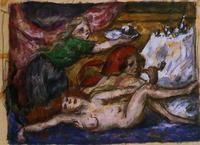
The Rum Punch
Paul Cezanne
Sleeping nude
Pablo Picasso
Rest on the bed
Edgar Degas
After the Bath
Edgar Degas
Make an attempt, second version
Edgar Degas
The festival of the owner
Edgar Degas
Breakfast after Bath
Edgar Degas
Nude Standing before a Mirror
Henri de Toulouse-Lautrec
Tranquility
Max Weber
Das Große Paar
Otto Mueller
Breakfast after Bathing
Edgar Degas
Two friends
Pablo Picasso
Three nudes
Pablo Picasso
Woman Leaving Her Bath
Edgar Degas
The Rejected Lover
Oskar Kokoschka
Afternoon in Naples
Paul Cezanne
Family of acrobats
Pablo Picasso
A Modern Olympia
Paul Cezanne