Paul Cezanne sanatçısının Boy in a Red Vest eseri hakkında uzman analizi
Tarz: Post-Impressionism · Tür: portrait
Expert Analysis: "Boy in a Red Vest" by Paul Cézanne
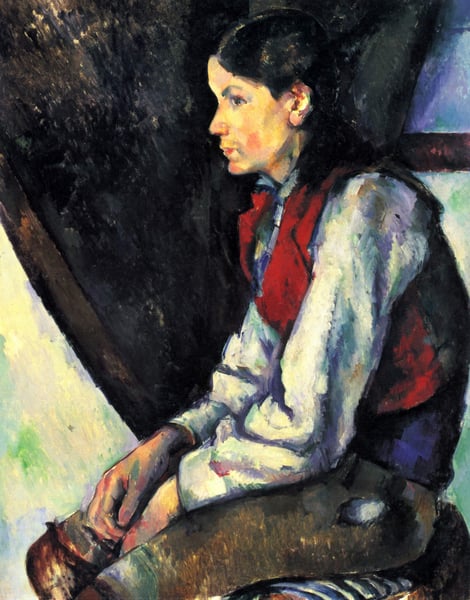
This portrait, created during Cézanne’s mature period, is a landmark work of Post-Impressionism that encapsulates the artist’s radical departure from the fleeting effects of Impressionism toward a more structured, enduring vision. The subject—a young boy in a vivid red vest—serves as a vehicle for Cézanne’s exploration of form, color, and spatial tension.
Significance within Post-Impressionism:
Cézanne’s mature style is defined by his systematic use of parallel brushstrokes and modulated color planes to build volume and depth without relying on traditional perspective or chiaroscuro. In Boy in a Red Vest, the bold red of the garment does not merely describe fabric; it anchors the composition and creates a rhythmic contrast with the cooler blues and greens of the background. This use of color as structure—rather than as descriptive or atmospheric effect—is a hallmark of Post-Impressionism and directly anticipates the color-field abstractions of the 20th century.
Significance as a Portrait:
Rather than focusing on narrative or psychological expression, Cézanne treats the boy’s face and body as a series of interlocking forms. The tilted head, the asymmetry of the shoulders, and the slight twist in the pose all serve to emphasize the two-dimensional picture plane while simultaneously suggesting three-dimensional mass. This tension between flatness and volume—between what is seen and how it is constructed—makes the portrait a study in perception itself. The work epitomizes Cézanne’s belief that the artist should “treat nature by means of the cylinder, the sphere, the cone,” a principle that profoundly influenced Cubism and later modernist painting.
Significance within Cézanne’s Mature Period:
Produced at the height of his career, Boy in a Red Vest demonstrates the artist’s mastery of simplifying form while enriching surface texture. The background, rendered in patches of blue, green, and ochre, pushes forward and recedes simultaneously, creating a shallow, ambiguous space that challenges conventional figure-ground relationships. This ambiguous spatiality is a key feature of Cézanne’s mature works and marks a critical step in the evolution toward non-representational art.
In sum, Boy in a Red Vest is not merely a portrait but a manifesto of Cézanne’s Post-Impressionist ideals: it asserts that formal structure and color relationships can carry as much emotional and intellectual weight as traditional subject matter, making it a foundational work for the modern art that followed.
Tür
Görsel olarak benzer
İlişkili kompozisyon ve renk paletine sahip 20 eser
Boy in a Red Vest
Paul Cezanne
Boy in a Red Vest
Paul Cezanne
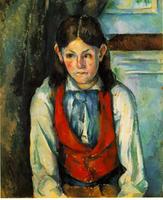
Boy in a Red Vest
Paul Cezanne

Portrait of a Young Lady
George Luks
Boy Saying His Catechism
George Harvey
Girl with a Blue Scarf
Gwen John
Peasant in a Blue Smock
Paul Cezanne
Moş Gheorghe
Rudolf Schweitzer-Cumpana
Portrait of the sculptor Jerónimo Suñol
Marià Fortuny
Head of a Neapolitan Boy in Profile
John Singer Sargent
Portrait of Madame Cezanne
Paul Cezanne
The Chamber Valet
Chaim Soutine
Young Man and Skull
Paul Cezanne
Odalisque
Iosif Iser
Woman with a Green Apron
Theodule Ribot
Portrait of a Young Indian
Fernando Botero
Young man
Christo Coetzee
Madame Cezanne in Blue
Paul Cezanne

Sewing Woman
Harriet Backer
In Erwartung
Wilhelm Leibl