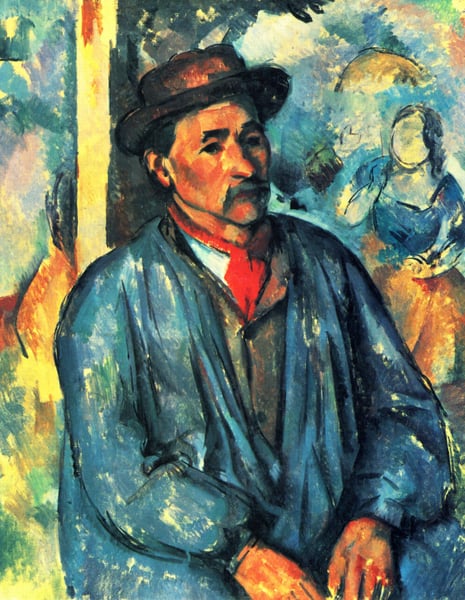
Peasant in a Blue Smock
Dettagli
Analisi esperta di Peasant in a Blue Smock di Paul Cezanne
Stile: Post-Impressionism · Genere: portrait
Expert Analysis: "Peasant in a Blue Smock" by Paul Cézanne
As a work from Cézanne's final period (c. 1895–1906), this portrait epitomizes the artist's radical shift away from traditional representation toward the structural and chromatic innovations that would lay the groundwork for Cubism and Modernism. Painted in his signature Post-Impressionist style, the piece is significant for its monumental simplification of form and its deliberate, faceted brushwork—a hallmark of Cézanne’s late oeuvre.
The subject, a nameless peasant, is stripped of psychological narrative or anecdotal detail; instead, Cézanne treats the figure as a geometric architecture within the pictorial space. The blue smock itself becomes a field of modulated color patches—blues, violets, and greens—that flatten the garment into a series of interlocking planes, echoing the artist’s famous dictum to "treat nature by the cylinder, the sphere, the cone." The face, rendered with minimal modeling, exists as a mask of abbreviated strokes, its asymmetry and slight distortion emphasizing the painting’s constructed, two-dimensional surface over illusionistic depth.
In its final-period context, this painting demonstrates Cézanne’s climactic synthesis of color and structure. The warm ochres and earthy tones of the background push against the cool blue smock, creating a taut visual harmony that feels both solid and vibrating. Crucially, the loose, exposed canvas and sketch-like finish reveal the artist’s process—each brushstroke visible as a discrete decision—making the painting a meditation on the act of seeing itself.
The significance lies in how Cézanne transforms a mundane rural figure into a pivotal bridge between Impressionist light and 20th-century abstraction. Where earlier Impressionists dissolved form in atmosphere, Cézanne rebuilds it through color-plane construction. This very approach inspired Picasso, Braque, and Matisse, who saw in such works a new language of pictorial reality. Peasant in a Blue Smock is thus not merely a portrait but a manifesto of late Cézanne: a quiet, radical rethinking of how art can embody the world through form alone.
Museum / Gallery
Genere
Stile
Visivamente simili
20 opere con composizione e palette affini
The beggar of Livorne
Amedeo Modigliani
Portrait of Vallier
Paul Cezanne
Six Friends of the Artist
Edgar Degas
The blue jacket
Mario Sironi
The Sailor
Paul Cezanne
Self Portrait Against a Window
Robert Falk
Self portrait against a window
Robert Falk
Self-Portrait in a Felt Hat
Paul Cezanne
Boy Saying His Catechism
George Harvey
Fisherman on the Beach
Vincent van Gogh
Portrait of a Man
Edgar Degas
Seated Peasant
Paul Cezanne
Man Smoking a Pipe
Paul Cezanne
Boy in a Red Vest
Paul Cezanne
Seated bearded man
Ferdinand Hodler
Portrait of Peasant
Paul Cezanne
Man with a Pipe
Paul Cezanne
The Smoker
Paul Cezanne
Self Portrait in a Hat
Paul Gauguin
Man with a Pipe (Study for The Card Players)
Paul Cezanne