Analisi esperta di Castle of Marines di Paul Cezanne
Stile: Post-Impressionism · Genere: landscape
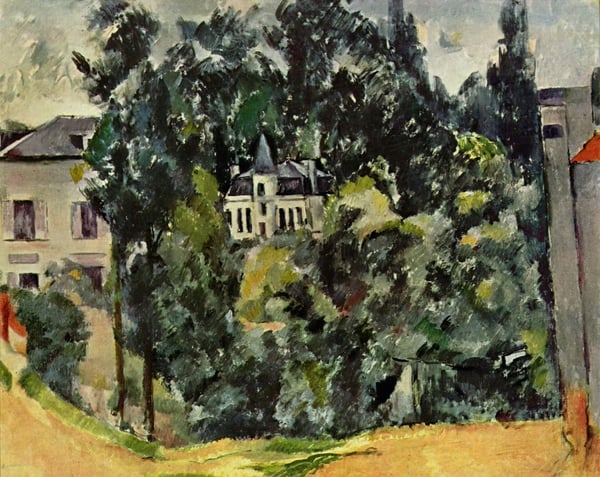
The Castle of Marines (also known as Château de Marines) is a quintessential work from Paul Cézanne’s mature period, created in the late 1880s or early 1890s. As a Post-Impressionist landscape, it demonstrates Cézanne's revolutionary shift away from the fleeting effects of light favored by the Impressionists toward a more structured, enduring vision of nature.
Significance within Post-Impressionism and Cézanne’s Mature Style
This painting is a masterful example of Cézanne’s “constructive stroke”—short, parallel brushstrokes of varied color that build form through modulation rather than line. The castle, perched on a rocky hill above a valley, is rendered not through detailed architectural contours but through a faceted arrangement of warm ochres, muted greens, and cool blues. These blocks of color suggest volume and solidity while flattening the picture plane, a technique that would later inspire Cubism.
Cézanne treats the landscape as a composition of basic geometric shapes: cylinders, spheres, and cones. The castle itself is simplified into a series of cubic masses, while the surrounding trees and hills are reduced to rhythmic, planar structures. The sky is constructed from layered horizontal bands of blue and white, echoing the stability of the earth below. This deliberate, analytical approach—where every brushstroke contributes to the overall architectural balance—is what distinguishes Cézanne’s mature landscapes from earlier Impressionist spontaneity.
Why It Matters
In Castle of Marines, Cézanne achieves what he called “a harmony parallel to nature”—not a literal copy, but a constructed equivalent of the scene’s underlying order. The painting bridges the gap between the sensory immediacy of Impressionism and the conceptual geometry of early Modernism. By emphasizing structure over anecdote, Cézanne transformed landscape painting into a vehicle for formal exploration. This work stands as a critical link in the evolution toward abstraction, influencing artists from Picasso and Braque to Matisse. Its significance lies in how Cézanne’s patient, almost architectural handling of color and form redefined what a painted landscape could be: not a window onto nature, but a self-contained, monumental composition in its own right.
Visivamente simili
20 opere con composizione e palette affini
Landscape
Paul Cezanne
Poplars
Paul Cezanne
Resnik
Nadezda Petrovic
Montalban, Landscape
Henri Matisse
The Rising Path, Pontoise
Camille Pissarro
Orchard in Pontoise
Paul Cezanne
Egry József, Olvasó Férfi a Szabadban.
Egry József
Landscape
Henri Matisse
First Fruit
Edouard Vuillard
A Turn in the Road
Paul Cezanne
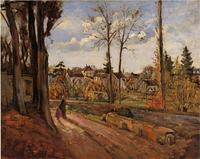
Louveciennes
Camille Pissarro
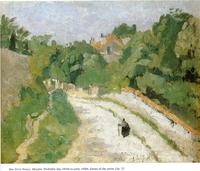
Rue Terre Neuve, Meudon
Gwen John
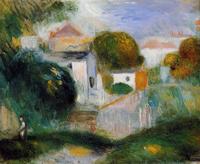
Houses in the Trees
Pierre-Auguste Renoir
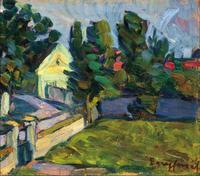
Egry József, Park 1910
Egry József
Evening, Siena
Clarence Gagnon
Berény Róbert , Borús Táj
Berény Róbert
A Cowherd on the Route de Chou, Pontoise
Camille Pissarro
Dans Le Jardin
Michel Kikoine
Road near Giverny 02
Claude Monet
Landscape with Red Roofs
Pierre-Auguste Renoir