Expert analysis of Paul Cezanne’s Chateau Noir
Style: Cubism · Genre: landscape
Expert Analysis of Paul Cézanne’s Château Noir (Final Period)
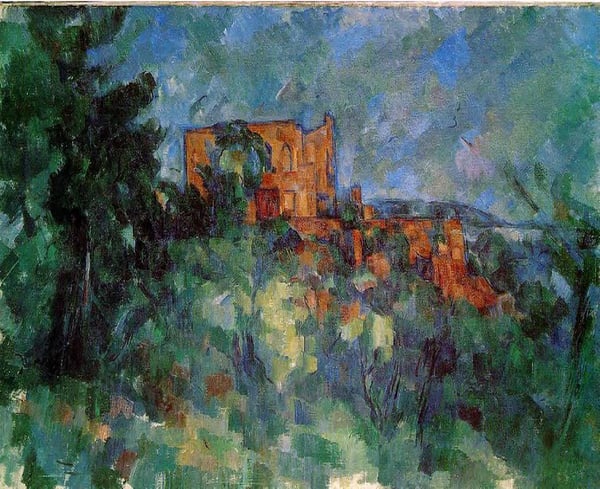
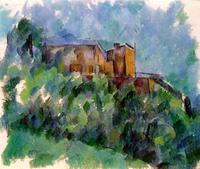
Paul Cézanne’s Château Noir, executed during his late (final) period, stands as a pivotal bridge between Impressionism and the nascent language of Cubism—a stylistic classification directly attributed to this work. As a landscape, it captures the dense, wooded estate near Aix-en-Provence, but Cézanne’s treatment transforms natural form into a rigorous, geometric architecture that prefigures the analytical breakthroughs of Picasso and Braque.
Significance within Cubism:
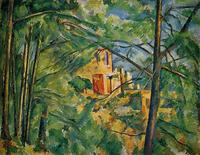
- Structural Decomposition: Cézanne reduces the château, trees, and hills to faceted planes of interlocking color. The building’s roof, walls, and surrounding foliage are rendered as stacked, tilted rectangles and triangles, dissolving traditional perspective. This “passage” technique—where edges between objects bleed into one another—directly anticipates Cubism’s fracturing of space.
- Shifting Viewpoints: The composition marries multiple vantage points: the château is seen both frontally and from above, while trees lean into the scene as if viewed from different angles. This synthesizes the Cubist principle of representing an object from several perspectives simultaneously.
- Color as Structure: Unlike Impressionist atmospheric play, Cézanne’s late palette—muted greens, ochres, and deep blues—is applied in disciplined, parallel brushstrokes that build volume through contrast, not light. The dark contours of the château roof act as “passages” that flatten and abstract depth, a hallmark of early Cubist painting.
Legacy in the Final Period:
- From Sensation to Concept: Château Noir epitomizes Cézanne’s shift from recording visual sensation to constructing a “harmony parallel to nature.” The dense, almost claustrophobic composition prioritizes the painting’s internal logic over naturalistic representation, a radical step toward non-representational art.
- Influence on Cubism: This work—and Cézanne’s entire late oeuvre—provided the formal template for Cubism’s grid-like compositions, monochromatic palette, and rejection of single-point perspective. Critics and practitioners alike (most famously Picasso and Braque) revered Château Noir as a manifesto of seeing through structure.
Conclusion:
Château Noir is significant not merely as a landscape of Cézanne’s beloved Provence, but as a cornerstone of modern art’s evolution. Its Cubist label underscores how this final period work dismantles traditional painting, replacing optical truth with a conceptual, planar geometry that would define the 20th century avant-garde.
Visually similar
20 works with related composition and palette
Chateau Noir
Paul Cezanne
Chateau Noir
Paul Cezanne
Chateau Noir
Paul Cezanne
Landscape of the South of France
Louis Valtat
Chateau Noir
Paul Cezanne
Landscape
Louis Hayet
Landscape at Midday
Paul Cezanne
At Les Petit-Dalles
Claude Monet
View of Bordighera
Theodore Robinson
View from Renoir's Garden in Montmartre
Pierre-Auguste Renoir
Summer in the Country
Joseph DeCamp
Corner of Quarry
Paul Cezanne
The Painter Taking a Stroll at Cagnes
Pierre-Auguste Renoir
Cabin with Aloe Plants
Pierre-Auguste Renoir
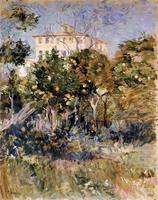
Villa with Orange Trees, Nice
Berthe Morisot
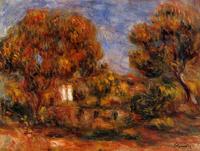
Landscape
Pierre-Auguste Renoir
Almond trees in Asis
Joaquín Sorolla
Fruit Tree
Richard Gerstl
The Plain of Veneux, View of Sablons
Alfred Sisley
The Suburbs of Rome
Fujishima Takeji