Expert analysis of Paul Cezanne’s Still life with fruits
Style: Post-Impressionism · Genre: still life
Expert Analysis: Paul Cézanne’s Still Life with Fruits (Mature Period)
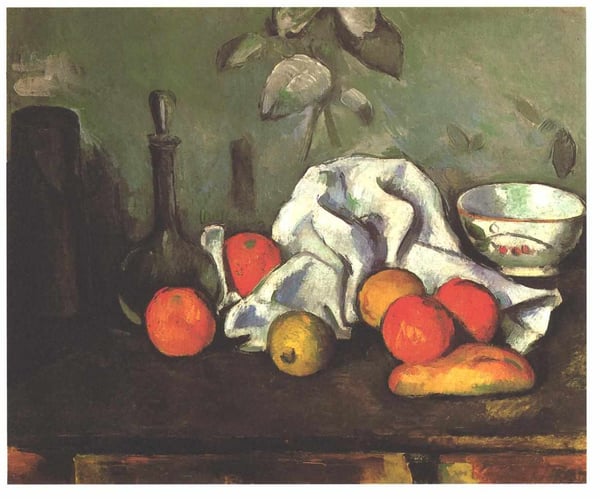
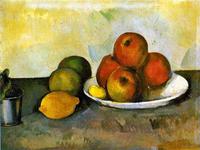
Paul Cézanne’s Still Life with Fruits exemplifies the revolutionary ambitions of Post-Impressionism during the artist’s mature period. As a still life—a genre Cézanne returned to obsessively—this work is significant for its radical departure from both naturalistic representation and the fleeting effects of Impressionism.
Key Significance within Post-Impressionism:
-
Structural Geometry and Pictorial Logic
In his mature still lifes, Cézanne abandoned conventional perspective in favor of a flattened, multi-viewpoint composition. Here, the tabletop appears tilted upward, the fruits are rendered as interlocking spheres, cylinders, and cones, and the background drapery breaks into faceted planes. This deliberate distortion was not a mistake but a method to assert the painting’s two-dimensional surface while preserving a sense of volume—a principle that would directly inspire Cubism. -
Color as Form-Building Tool
Rather than using local color, Cézanne modulates hues to model form. Warm oranges and reds advance; cool blues and greens push back the space. The fruits are built from juxtaposed touches of pure color, creating a vibrant, almost sculptural mass without relying on traditional chiaroscuro. This approach redefined how color could construct depth and weight on a flat canvas. -
The “Mature Period” Synthesis
During this phase, Cézanne balanced his earlier romantic intensity with classical order. The composition is carefully orchestrated: the asymmetrical arrangement of fruits leads the eye in a serpentine path, while the white cloth and jug anchor the scene. Every brushstroke—articulate, parallel, and deliberate—contributes to a unified architectural whole, transforming a humble still life into a monumental meditation on perception and structure.
Why It Matters:
Still Life with Fruits is a cornerstone of Post-Impressionism because it demonstrates Cézanne’s conviction that the artist must interpret nature through a personal, structural language—one that prioritizes the essential forms underlying appearances. This work directly paved the way for 20th-century modernism, proving that still life could be a vehicle for profound formal exploration rather than mere imitation.
Museum / Gallery
Visually similar
20 works with related composition and palette
Fruit Bowl, Pitcher and Fruit
Paul Cezanne
Still life with apples and green vase
Paul Gauguin
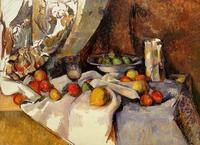
Still Life Post, Bottle, Cup and Fruit
Paul Cezanne
Still Life with Apples and Jug
Kmetty János
Still Life
Pierre-Auguste Renoir
Fruits in Blue Bowl
Kmetty János
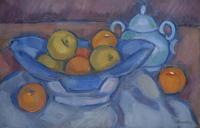
Fruits in Blue Bowl
Kmetty János
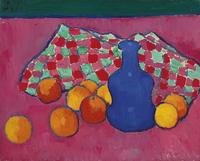
Blaue Vase mit Orangen
Alexej von Jawlensky
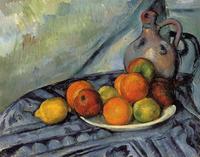
Fruit and Jug on a Table
Paul Cezanne
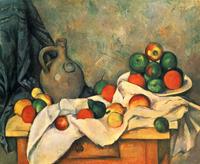
Curtain, Jug and Fruit
Paul Cezanne
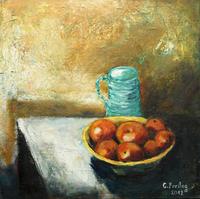
Apples and Cider
Gazmend Freitag
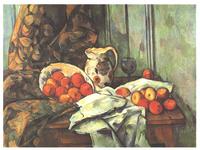
Still life with jug
Paul Cezanne
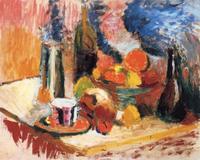
Still Life with Fruit
Henri Matisse
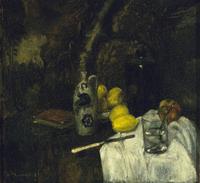
Lemons and Bottle of Dutch Gin
Henri Matisse
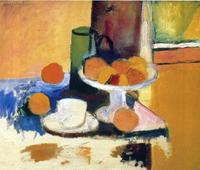
Still Life with Oranges II
Henri Matisse
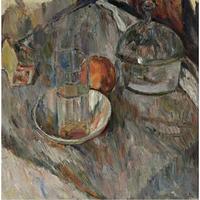
Still Life with Glass
Abraham Manievich
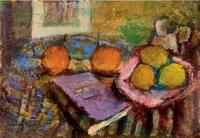
Modok Mária, Csendélet Gyümölcsel
Modok Mária
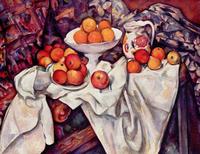
Apples and Oranges
Paul Cezanne
Still life with Apples
Paul Cezanne
Still life with fruit
Gregoire Boonzaier