Expertenanalyse zu Paul Cezannes Etude - Paysage a Auvers
Stil: Impressionism · Genre: landscape
Expert Analysis: Etude - Paysage à Auvers by Paul Cézanne
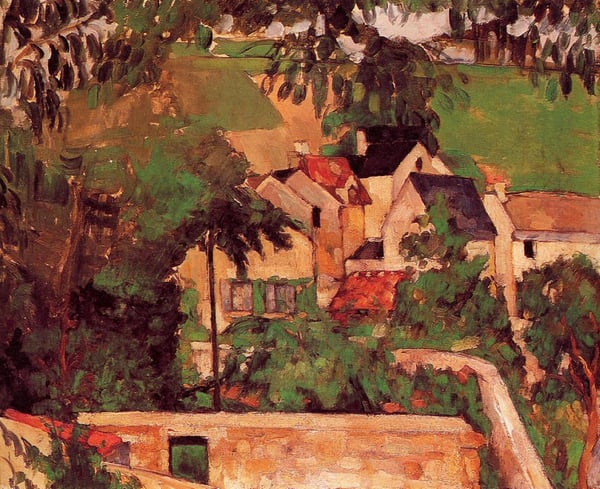
Paul Cézanne’s Etude - Paysage à Auvers (Study – Landscape at Auvers) is a compelling example of his early engagement with Impressionism, yet it already hints at the structural rigor that would later define his revolutionary contributions to modern art. While the work conforms to the Impressionist landscape genre—captured en plein air in the village of Auvers-sur-Oise, where Cézanne worked alongside Camille Pissarro in the early 1870s—it is significant precisely because it reveals Cézanne’s struggle to reconcile the fleeting, sensuous effects of light with a more enduring sense of form.
Significance within the Impressionist Period:
-
A Transitional Masterwork: Executed during the peak of Impressionism, this painting exemplifies the movement’s signature concerns: broken brushstrokes, a bright palette, and an emphasis on atmospheric conditions. Yet Cézanne’s handling is notably more deliberate and architectonic than that of his peers. Where Monet or Sisley might dissolve a hillside into shimmering patches of color, Cézanne builds the landscape with parallel, hatched strokes that simultaneously record light and suggest volume. The “étude” (study) quality underscores his methodical, analytical approach—a precursor to his later dictum to “treat nature by the cylinder, the sphere, the cone.”
-
Foreshadowing Post-Impressionism: Etude - Paysage à Auvers is a crucial link between Impressionist spontaneity and the geometric abstraction that would follow. The composition is organized around earthy ochres, greens, and blues, but a subtle layering of complementary hues (e.g., touches of orange against green) creates a vibrancy that is still grounded in structure. Cézanne’s simplification of the foliage and distant buildings into blocky, almost faceted planes anticipates the Cubist revolution. Art historians often cite his Auvers landscapes as the moment he began “constructing” a painting rather than merely recording a sensation.
-
Influence on 20th-Century Art: This work’s significance extends beyond its immediate period. By prioritizing formal unity over transient effect, Cézanne offered an alternative path out of Impressionism—one that would inspire the analytical experiments of Georges Braque and Pablo Picasso, as well as the color-field innovations of the Fauves. Etude - Paysage à Auvers stands as a quiet manifesto: even within the Impressionist canon, Cézanne was already shaping the language of modernism.
In sum, the painting is not merely a pretty landscape but a laboratory of ideas. It captures Auvers’ light while forging a new visual syntax—one that balances observation with invention, nature with geometry. That tension makes Etude - Paysage à Auvers a landmark of Impressionist period art and a cornerstone of Cézanne’s legacy.
Museum / Gallery
Genre
Stil
Visuell ähnlich
20 Werke mit ähnlicher Komposition und Farbpalette
The Hermitage at Pontoise
Camille Pissarro
Houses of l'Hermitage, Pontoise
Camille Pissarro
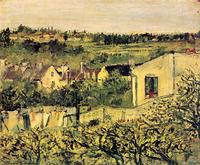
La Butte Pinson
Maurice Utrillo
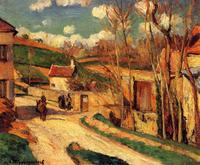
Crossroads at l'Hermitage, Pontoise
Camille Pissarro
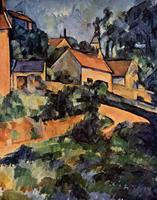
Turning Road at Montgeroult
Paul Cezanne
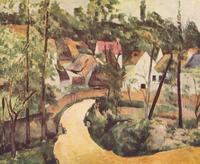
A Turn in the Road
Paul Cezanne
In the Oise Valley
Paul Cezanne
Coast at Chaponival
Gustave Loiseau
Geese in the meadow
Paul Gauguin
Red Roofs, Corner of a Village, Winter
Camille Pissarro
Béla Czóbel
Bela Czobel
The House of Pere Lacroix in Auvers
Paul Cezanne
Kitchen Gardens at l'Hermitage, Pontoise
Camille Pissarro
Swineherd, Brittany
Paul Gauguin
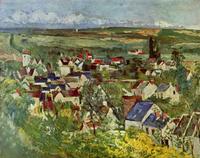
View of Auvers
Paul Cezanne
Village on the hill
Gustave Loiseau
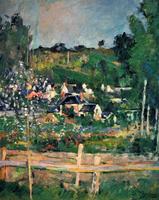
View of Auvers
Paul Cezanne
Landscape at Osny near watering
Camille Pissarro
Les mathurins, Pontoise
Camille Pissarro
View of Osny near Pontoise
Camille Pissarro